FGF21, Protein Restriction, The "Sugar Diet" and "Intermittent Fatting"

I’m honestly not sure where I’m going to go with this, but let’s kick this off.

For folks that are in the social media spaces, “The Sugar Diet” is trending pretty seriously right now, with Mark Bell really leading the charge at the behest of Cole Robinson (aka “The Snake Diet” guy).

This diet is predicated upon the idea of greatly limiting dietary fats AND proteins and, in their absence, consuming a high sugar diet. Mark Bell and Cole refer to the period of time spent eating sugar in the absence of other macronutrients as “sugar fasting”, and it includes fruit, fruit juices, honey, maple syrup, sugar and (fat free) candy as sources. After a few days of fasting, the fast is broken with lean protein and starches, still keeping the fats on the low side.

The reasoning for this approach is that, in theory, it results in the increased secretion of Fibroblast growth factor 21 (FGF21), of which there is a LOT to read about, but ultimately, this hormone plays a role in lipid metabolism, insulin sensitivity and glucosoe homeostasis, and by increasing the secretion, energy expenditure increases as well. Effectively, the metabolism gets revved up.

However, what’s unique is that, it appears FGF21 is macronutrient agnostic, in that it is ultimately triggered merely in the absence of PROTEIN. Which is to say: one could use a sugar fast OR one could employ a fat fast instead.

Robert Sikes (the keto savage) and Dr. Shawn Baker (writer of "The Carnivore Diet) both undertook their own n=1 experiments to test this theory, with Robert Sikes eating a 4:1 fat to protein ratio diet in a 1000 calorie surplus (4000 calories a day for a 180lb athlete) and LOST weight during that time, while Baker, as a 6’3 250lb athlete ate a more modest amount of food at around 2300 calories a day and predictably lost weight but ALSO was able to perform well athletically. Sikes ran this for 2 weeks, Baker for 3 days. It’s also worth appreciating that Sikes literally doubled his testosterone (free and total) during this time.

Apparently Nick Norwitz is running a similar experiment: I’m excited to see his results.

There are many theories regarding why the body upregulates FGF21 in the absence of protein. Some suggest it may be a survival mechanism: basically making the body more alert and energy in a period of perceived starvation so that it has the capacity to hunt and obtain a protein source.

But ultimately, what I really dig about all this is what we, here on t-nation, heard all about this before from one of our (sadly no longer prolific) posters @EyeDentist , who wrote about “intermittent fatting”
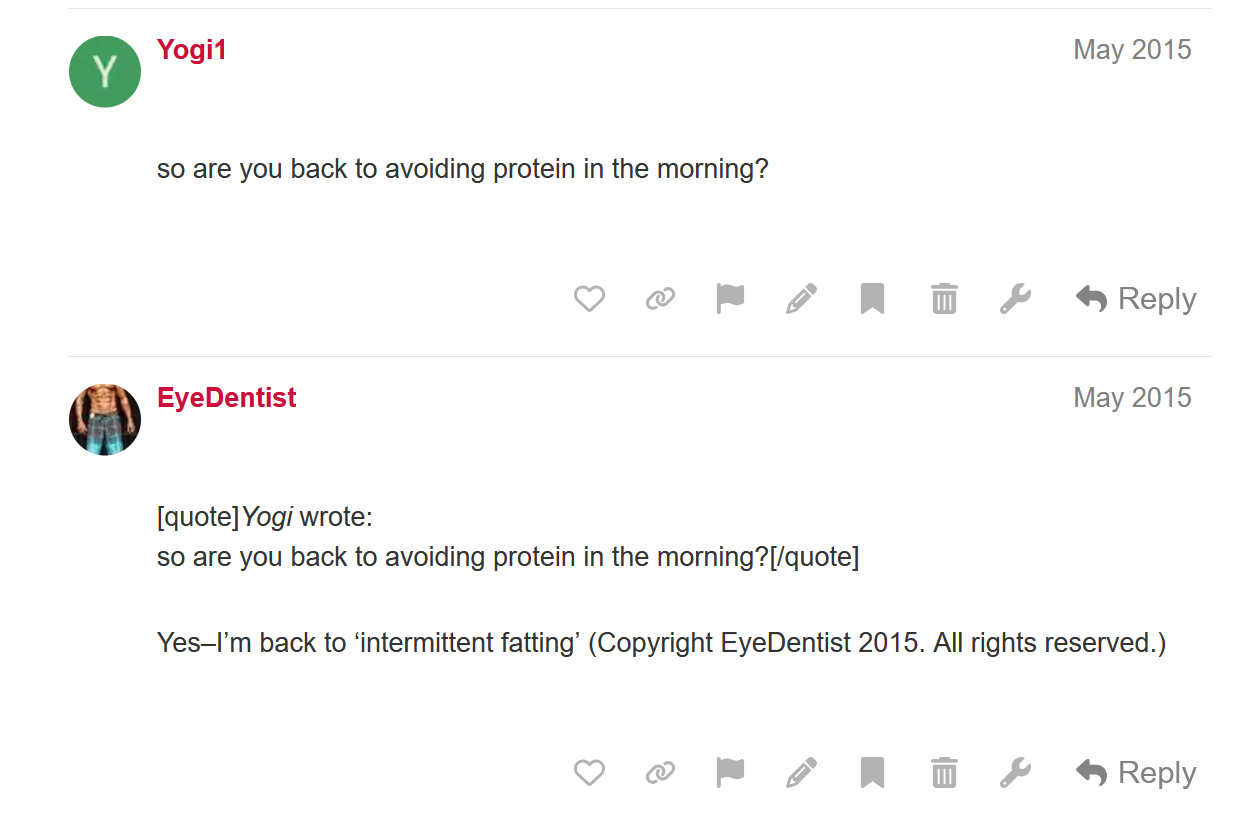
EyeDentist’s first mention of that goes back to 2014, but I’m not sure when he actually first started implementing the idea (maybe he’ll see the tag here and enlighten us), but it’s honestly just wild and goes to speak to the notion that there is nothing new in the realm of fitness.

Take with this information what you will. It’s pretty wild how FGF21 maximization is effectively the polar opposite of the Velocity Diet, and makes me wonder how a cyclical approach of both extremes would work. One could attempt such an approach by doing opposite ends of a Metabolic Drive based diet followed by a Surge based diet.

6 Likes

I’m glad you made a topic covering this. I first heard about sugar fasting from Kali Muscle doing a watermelon-only diet about a year ago, but Mark Bell getting ripped on his sugar fast made me pay attention. Definitely an interesting concept for sure, although I’d personally be more inclined to try it with fats over sugar (plus “intermittent fatting” is just a fun name).

1 Like

I remember being aware of KailMuscle doing some sort of fruit binge thing, and honestly didn’t pay it any mind just because I assume everything he’s doing is a social media stunt. Interesting to see it gaining traction.

Robert Sikes experience definitely has me interested in the fat based approach. That said, it’s really like trying to solve a nutritional puzzle when you try to take in fats without overconsuming protein. I can see the appeal of “sugar fasting”, since there are a lot of no-protein sugar options out there (which honestly speaks to our nutritional landscape and the obesity epidemic), but for fats it ends up having to be a lot of tallow, butter/ghee, and macadamia nuts/nut butters.

EDIT: Hah, I brought up Nick Norwitz earlier and it turns out he did a video on the sugar diet wherein he references a study where they swapped out carbs for fats while keeping the protein restricted and achieved the same effect, so it seems like it’s getting more and more documentation that it’s the protein restriction rather than the sugar that’s ultimately at play here

2 Likes

Great read – and a cool shout out to EyeDentist!

1 Like

Same pattern as always. Low fat fads bleed to low sugar, monetizing angles dry up and someone comes up with some sort of twist like only eating every 8 hours, 6 minutes and 3.345678392876537212395837262537 seconds on the dot and we cycle back around.

Then, each is taken to an extreme, extrapolated from a niche bodybuilding cut phase (and ignoring massive drug intake) and is packaged and sold as an ongoing “lifestyle” to the public instead.

And in the end, calories are simply being cut from somewhere but in the extreme diet cases so are nutrients :man_shrugging:t3:

@burien_top_team Much appreciated dude! He’s missed.

Low fat fads bleed to low sugar

This is why I found it unique to be low protein. I’m not used to seeing THAT macro come under fire. Usually the opposite, with folks like Dr. Ted Naiman talking about protein leveraging, along with all the protein overfeeding studies. Outside of a clinical ketogenic diet, this is going in a different direction than the usual trend.

And in the end, calories are simply being cut from somewhere

This makes Robert Sikes experience pretty fascinating, yeah?

2 Likes

Double the test and less fat in 2 weeks?

Hey Oh!

1 Like

All while drinking 4000 calories of butter: how can you lose! Haha.

1 Like

Or whiskey glasses full of safflower oil like Power and Bulk icon Anthony Ditillo.

It could be fun to give this a shot!

1 Like

Semi interesting imo.

So far I see various interpretations of the sugar diet and many include fruits and certain vegetables, in which case we have basically circled back around to a well balanced diet, albeit with shitty snacks.

I do see where some interpret the diet to mean candy and other refined sugar as a primary fuel source is but anticipate a Saladino style reversal on the horizon.

Mark Bell seems to be the most prominent proponent of the sugar diet for now, and from what I’ve read he is basically eating lots of fruit and veggies as the backbone, does incorporate protein and fats in almost a loading pattern and advertises with candy for attention.

We are basically seeing another version of shifted calories and rebalanced macros with lenient snacks in the mix. I personally don’t think it should be a surprise that one can build muscle and lose fat by eating fruits and vegetables with meat and even some junk food. We’ve since this before as IIFYM and a “well balanced” diet from a pyramid.

And while laissez faire attitude about refined sugar is apparently working for a well trained athlete with a lot of built in tolerance, the masses are going to fuck up and this won’t end well for their health.

1 Like

I don’t know if I’ve seen one that doesn’t. In many cases, it’s the crux. Although I don’t see much veggies during the fasting portion: only when the fast is broken.

I find that an interesting interpretation, given the necessity for low protein. Even with the loading approach mentioned, someone like Mark is taking in like 120g of protein every 2-3 days. If one can do that while sparing muscle in a fat loss phase, that seems interesting to me.

What I find unique about it is how it seems to be impacting the “calories out” portion of the CICO equation.

That’s been one of the critiques I’ve seen as well. That one needs to be metabolically healthy FIRST before employing such an approach. I’ve seen a similar reasoning employed regarding consumption of refined/processed sugars in general.

To @Njord 's point, Cole and Mark–at least from what I’ve seen–keep changing their protocols. I think Mark started increasing his protein intake a while ago and Cole is now suggesting eating high carb, unlimited lean protein, and keeping “fat through the floor.”

I tried the sugar diet–the no protein until dinner version–for about three weeks while doing minimal lifting and no conditioning. I didn’t experience miraculous fat loss, but also didn’t gain noticeable fat while eating boxes of cereal, fruit dipped in honey, and drinking soda. I “felt” like I was slowly getting leaner and plan to give it another shot in the future when training takes a front seat.

1 Like

Appreciate you sharing your experience! I am wondering if there would be a place for such an approach as it relates to metabolism building, similar to what Justin Harris, Shelby Starnes, and Robert Sikes have spoken about. Not just reverse dieting, but trying to get a trainee out of the metabolic hole dug from too extensive of caloric restriction and get them to a place where they can take in enough food to actually get all the nutrients they need.

Got 6 fully melted liquified Keto Bricks in the mail yesterday

Melted AND liquefied eh?

Did you follow the instructions on what to do when that happens?

I think bags of candy could certainly reverse a “metabolic hole” created by calorie restriction. I would hope so. Could potentially reverse it right in to diabetes.

Fruits, vegetables and even lightly processed grains could go very far here too, with the added benefit of nutritional density.

Sounds a lot more sarcastic than intended in type.

This is basically what Mark is doing anyways. The candy is his marketing hook. Same old industry song and dance.

This is basically what Mark is doing anyways. The candy is his marketing hook. Same old industry song and dance.

I guess I’m not used to seeing protein restriction as part of this marketing hook you keep referencing. Would you mind providing some examples of things you’ve seen during your time that align with this?

Like, going all the way back to John McCallum writing The Keys to Progress series, protein has ALWAYS been held up as like THE macro to emphasize and never compromise. But from what I’m gathering form you, that was actually a rarity, and we’ve been seeing protein restriction as the norm for a while.

Like, all I can think of is dudes like John Harvey Kellogg who promoted a low protein diet, but this wasn’t at all for physique improvement: it was his approach to intestinal health and curbing sexual urges. We saw it with some cult leaders as well.

As for Mark, perhaps I’m missing some videos where he says he’s eating vegetables and grains during his sugar fasting. I’d love to see the supporting material you’re talking about. Everything I’ve heard from him so far emphasizes that, during the fast, it’s fruit, fruit juices, honey, maple syrup, sugar and candy. It seems the veggies and grains occur during the non-fasting period.

He’s not restricting protein.

Ok, now that IS news to me. He includes protein during the sugar fasting?

His whole premise is balancing carbs and other macros. You’re over complicating the hype piece. The diet includes proteins, fats, carbs ….. sometimes in the form of candy.