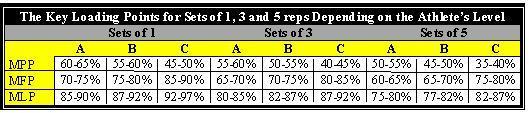
There are three ‘loading points’ that you need to understand and master to be able to autoregulate your training with ease, get maximum progress and zero chance of overtraining.
NOTE THAT THE GRAPHIC UTILIZE SETS OF 3 REPS… WITH HIGHER OR LOWER REPS THOSE PERCENTAGES WOULD NEED TO BE SLIGHTLY ADJUSTED
These are:
- Max Power Point (or threshold). This is the lightest load you can use and still produce a high level of force with if you try to accelerate the load. Beginners normally have a higher MPP relative to their limit strength, simply because they are not able to utilize a large amount of their resources or strength potential because they are not efficient at a movement yet.
For example their actual maximum on a bench press might be 125lbs but their muscles have the potential to lift 200lbs. They thus need a higher percentage of their ACTUAL maximum (125lbs in this case) to be able to produce a significant degree of force. Force = mass x acceleration… at some point, the load can be too low to lead to a significant force production for that person, even if he accelerates.
By the same token, an elite lifter will need a lesser percentage of his maximum to reach a load sufficient to produce a high level of force.
A good example of this is that Westside lifts originally did their speed work with 60% (even 70% in some cases) but as they got stronger they experienced better results by going down to 50% then to 40%.
This is one of the reasons why a beginner with very low strength levels (compared to his potential) would not benefit optimally from an actual advanced Westside-inspired program; speed work would still work for him, but he would need higher loads to accomplish the same goal.
-
Max Force Point (MFP): This has already been discussed in the past. This is the heaviest weight you can still dominate for all your reps. More on that later.
-
Max Load Point (MLP): This is the heaviest weight you can lift without having a sticking point in an exercise. This is normally right before the grinding. If you were to do one more set with a slightly heavier weight, you would grind for at least a repetition. The more advanced lifters, especially those with a power training background and an efficient nervous system, will have a lesser gap between their max force point (MFP) and their max load point (MLP).
In fact, elite power athletes like olympic lifters, sprinters and throwers often have next to no difference (their max force point and max load points are the same). These athletes almost can’t grind. They either make the lift (and it seems relatively easy) or they don’t (and it’s not even close) there is no in-between.
Ideally you want to train between the MPP and MFP most of the time, with some work going up to the MLP (probably once every 3-4 weeks).
As you can see, it shows that the more efficient your nervous system gets, the wider is your training zone and the more you can push yourself without overloading the nervous system. Beginners have a shorter range to work with and can more easily go overboard. This is one of the reasons why looking at percentage-based programs of elite lifters is not always a good idea.
If your nervous system is not up to par with their, you are very likely to overload the nervous system. For example, a squat routine might call for tons of sets in the 85-90% range which is fine for an elite lifter (because they are still below their max load point) whereas for beginners they will be either exceeding their MLP or always be on the edge, which can be hard to recover from.
This could be one of the reasons why some people report amazing gains for a Sheiko program while others get overtrained real fast. Or why some are getting results initially then crash after a few weeks.