No, it hasn’t. You have to be a troll.
1 Like
When you push yourself, you enhance the force generated by your muscles against the resistance, which increases mechanical tension.
Intensity of effort is a means to maximize mechanical tension, it is not a separate process.
Mechanical tension is the primary driver.
2 Likes
incorrect- you can have mechanical tension without intensity of effort, but not the other way around. iNTENSITY OF EFFORT>
The idea of pre-exhausting smaller muscles to concentrate on bigger ones is not that unusual. Ian King had routines where the triceps would be occasionally worked hard before benching (at somewhat lower weights) to better concentrate on the pecs. I’m just not sure the idea of pre-exhausting major muscles is as helpful, especially when the exercise includes a dozen other muscle groups so you aren’t isolating much.
But with weightlifting advice, sometimes you have to smell it and see.
ok thats the wrong way to pre exhaust. the idea being pre exhaust is to weaken the muscle which does not get adequate stimulation from the compound excercise and by weakening it prior to do the compound you allow for it to fail, but you do not pre exhaust the failure point muscle. So your bench gives out not because of your pecs failing but because of your triceps failing, therefor why pre exhaust the triceps? you would want to pre exhaust the pecs. Another example would be to do barbell curls before a back movement, when your back movements are limited by your biceps anyways. so these are wrong implementations.
The correct methods are as follow:
Pec fly + Bench press
Pullovers + Chin Ups
Leg Extensions + Squat
explanation-
pullovers pre exhaust the lats and then chin ups to use your fresh biceps to push the pre exhausted muscle into a deeper inroad.
pec fly to pre exhaust the pectorals and then pressing movement to use your fresh triceps to push the pre exhausted pecs into a deeper inroad.
leg extensions to pre exhaust the quadriceps and then squats to use your fresh glutes to push the pre exhausted quads into a deeper inroad.
I don’t know more than Ian King. I presume some bench pressers like myself are triceps dominant. Others rely more on their pecs, which the bench press is supposed to develop.
So if you are weak off the chest since you use your triceps more, it makes sense to develop your pecs by pre-exhausting the triceps to overcome that weakness.
So I see preexhaustion as a way to help with specific weaknesses. A squat uses something like 250 muscles. Deadlifting also uses many. Both are effective because the weights used can be very heavy. But since so many other muscles are involved, removing one group might make less of a difference.
If you have dominant pecs on the press and want more triceps practice, I could see doing pec deck first along with more dips.
Chin-ups work the lower traps and lats, but really, every muscle from your fingers to your glutes is involved. I’m not sure removing the lats to emphasize biceps is better than just adding weight once you can do ten full reps with bodyweight. But if it works for you…
I give pre-exhaust zero credit for the physique that I managed to develop. In fact, IMO, it was a negative contribution.
This thread is about hamstring development. Albeit, via pre-exhaust methodology. But I have an exercise suggestion that I felt had a significant role in the development of my hamstrings.
I did dumbbell lying leg curls, holding the dumbbell on the bottom of my shoes with the inner sides of the ball of my feet pressed together to keep the dumbbell from sliding out at the bottom of the exercise. (Note: I only used dumbbells that were plates, so the surface of the dumbbell had maximum contact on my shoes.)
I felt that the tension of keeping the weight from sliding off my shoes increased the involvement of the semitendinosus and semimembranosus curling the dumbbell. It was a different feel.
To start this exercise you will likely need a workout partner to place the dumbbell on the bottom of your shoes. As you get accustomed to this you will be capable of lifting moderate weight without help.
The maximum felt resistance is in the extended position. You might feel this dangerous from an injury perspective. I never got injured and had worked up to a 150lb dumbbell.
Im not sure either if adding more weight works better than pre-exhausting
but that seems to be the reasoning behind it is doing a pre exhaust with lesser weight gives you the same or better growth than doing a normal set of that exercise for that muscle.
otherwise why even implement the pre exhaustion? i know for my quads, doing pre exhaust leg extensions and squats at a lesser weight = better gains the more weight on the squat.
and to your point earlier in your post, this isn’t a mechanical tension thing of muscles worked. when choosing an exercise It’s about what allows the most intensity of effort, and then you decide on exercise that don’t overlap or overlap the least so you don’t go to double failure on the same muscle thus hindering recovery progres.
if you wanted to adequately stimulate a weak muscle you just have to work it harder.
if your chest is weak/understimulated why would you pre exhaust your triceps and not your pecs?
and to your point of pre-exhausting the triceps and then doing pressing movements- why that doesn’t workout too well is your pecs aren’t gonna help that much in your triceps to push beyond failure, but your triceps are gonna help your pecs push beyond failure.
thanks for the information and yes im considering this, i believe in the lying leg curl because it makes sense in theory but i haven’t used it much. my hamstring development was significant from conventional deadlifts, however im trying to eliminate overlapping. So im thinking of lying leg curls, now you’re saying this dumbbell on the bottom of your shoes thing would work even better than lying leg curls? i’ll try it if that’s the case. or if it is similar to the lying leg curl i will do that and forget any pre exhaustion idea.
I would say it is better said that it different. Why not do both, especially if do train hamstrings twice a week.
1 Like
in the words of arthur jones- minimum exercise required for maximum growth without impeding recovery- that is the reason why not both
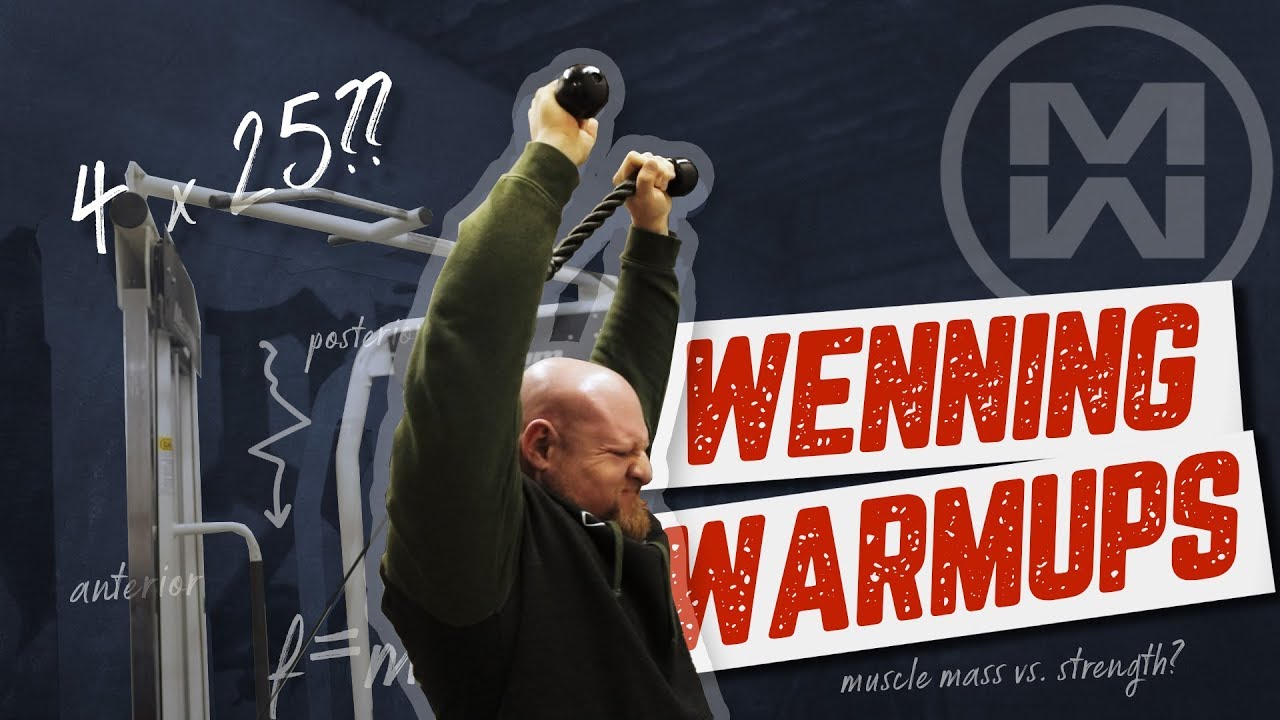
If it helps, Matt Wenning likes to implement wenning warmups before starting your working sets.
You pick 3 exercises that target a weakness and then do 4 sets of 25 with each movement.
I question the strategy but if it works for you, it works.
Assume bench pressing only involves the triceps and pecs, and say your triceps are stronger so you rely on them more than pecs, and that as a result you are weak at the chest but strong at the top.
One of the reasons bench is done is because most people can simply move a lot more weight bench pressing than they could with, say, a preacher curl. The heavier weight is a growth stimulus.
If you want your pecs to work more, to address your weak spot, you might want your triceps to work less. So if you do dips until the triceps are tired, when you bench the triceps won’t be able to contribute as much as usual. Pre-exhaustion of the triceps means they don’t contribute much to the heavy bench so you are forced to strain the pecs.
“Deeper inroads”, whatever that means, does not mean the triceps, once exhausted, are suddenly magically able to do the same amount of work as before but also have a new growth stimulus. It’s not the same as a gentle warmup.
I wasn’t saying on the same day was necessary.
1 Like
warming up like that is energy wasted. forget this.
might be a point to not do it on the same day, but i meant recovery as in within the vacuum of a workout routine. it is best to avoid overlaps. for recovery.
i see what you mean… but this would only give you exhausted triceps which would further reduce the pecs involvement in your pressing, if you want your chest to improve, regardless of how over powering your triceps are, then you would pre exhaust the chest not the already easy to stimulate triceps.
After giving his methods a try, I ignored everything he “demanded” was what was required for best gains.
Let’s consider the con man Arthur Jones was. Consider all the Nautilus machines he made for about every possible exercise. Most of the chain driven stuff he made had more internal resistance than about any other machine that I have ever used. Internal resistance works against the positive movement making it more difficult, while also working against the negative movement making it easier. He got it exactly backwards. I bet he knew, but didn’t care. He just sold you a robust industrial grade anchor.
Give me the free weights. Hammer. I really liked plate loaded Strive equipment: probably the best leg extension machine ever made.
1 Like
The idea of pre-exhaustion is to fry smaller muscles before working bigger ones. It’s much harder to generate power from exhausted muscles. So you have to rely on larger fresh ones.
I suspect it doesn’t work as well if you fry large muscles. I agree that I haven’t found pre-exhaustion very useful myself. There are other many techniques that work better for me, especially heavy singles EMOM. But I ain’t you. I don’t know what your goals are.
why is this even a discussion. it isn’t me being a fanboy of old-arthur, anybody who could’ve came up with it would get the kudos of finally inventing something far ahead of the free weights, he not only created machines that are full range but also compensate for the different stregnth curves of that muscle and tension curves of that exercise.