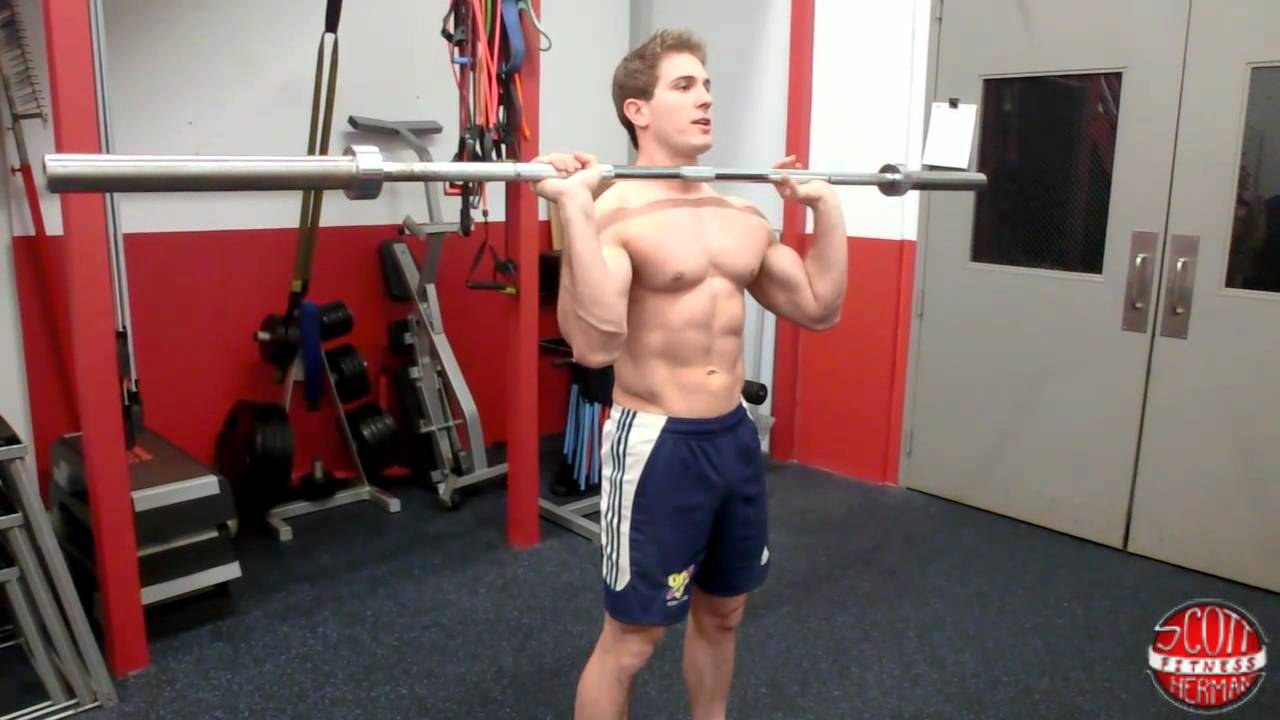
[quote]flipcollar wrote:
[quote]LoRez wrote:
The way the OP is currently lifting is dangerous, based on the torque on the lumbar spine from his arch, as well as the torque on his wrists from not holding the bar over his forearms. A basic knowledge of anatomy and physics is all it takes to understand that. No need for years of seasoned effort under the bar to point out that it’s dangerous, and point out corrective measures.
[/quote]
Also, your assertions about ‘basic anatomy’ and how it relates to torque may be overstated. To actually prove what he’s doing is dangerous from a physics perspective, you’d have to go into a lot of numbers, not just concepts. Tissue density (bone and soft tissue), angles (which can’t be measured from the video), weight being handled versus capacity, etc.
This is why it’s important to either: a) have a much more solid foundation in physiology than a class or 2, plus internet reading, or b) have experience. If you can speak from either of these perspectives, you can give much better advice.
[/quote]
Tissue density is completely irrelevant here.
Take this shot of the wrists, for instance:
Torque is a measure of the distance between a point and a load, times the perpendicular force exerted by the load. If the bar is directly over the forearms, the torque on the wrists is 0 ft-lb.
Now if I read it right, the bar is 145 lbs. And it looks like the bar is 3-4" from that point of rotation. Let’s say it’s 3". His wrists are dealing with ~36ft-lbs of torque from the bar by holding it that way. Sure, his tendons can handle it just fine there. But it’s an unnecessary strain that can be avoided simply by holding the bar with his wrists straighter, and one that scales linearly as he adds weight. At some point, his tendons will become a limiting factor if he keeps that practice up… not his shoulders, not his triceps, his wrist tendons.
If he were to hold his wrists much straighter, and the bar was roughly .5" away from that point of rotation, the torque on his wrists is only 6 ft-lbs of torque. However, given that at .5" out, it’s no longer a 0 degree angle between those points because the palm is thicker (it’s closer to a 30-45 degree angle) the perpendicular force isn’t 145 but actually 102-126lbs, which means the torque on his wrists is actually only 4-5 ft-lbs of torque.
The difference between being being almost vertical, to how he has it now, is a 9-fold increase in force on his tendons in his wrists. Let’s say he doubles his military press strength… his wrists are going to have to be dealing with 18 times the force they would be if he were just holding 145 mostly vertical.
Can his wrists take it? Maybe. Would it be safer to keep his wrists more vertical to avoid damaging a tendon or tearing a muscle in his forearms? Yes.
In the case of the force produced on the lumbar spine by arching his back forward… it’s actually not a linear relationship. Just a little bit more arch than he has, and the force increases significantly. It’s not an exponential increase, but it’s more than linear. Given that his stomach is distended in the photo, the horizontal forces from that loading are not being distributed across his core very evenly, and are being borne by his lumbar spine to a significant degree.
If he reduced that curvature, it would reduce those forces quite a bit. He could also use the valsalva maneuver to distribute the load-bearing across other tissue in his midsection; without IAP, the rear of the abdominal cavity bears most of the load, but with IAP, that load can be distributed across nearly the entire midsection.
By doing both – as I suggested – it will reduce the strain on his lumbar spine, and reduce the risk of injury if he ever somewhat gets off balance during the pressing phase (like, say, if his shoulders or arms start giving out, and the load becomes a bit unstable.)
The issues with form and how it affects torque is clearly visible in this video. The physics behind that are very straightforward. The form cues I suggested will reduce the loading to his wrists and lumbar spine, which will reduce the risk of injury.
The details of intra-abdominal pressure are a little less obvious, and the physics are slightly more advanced, but again, it doesn’t require a genius to know that a pressurized object exerts more stability than a non-pressurized one (e.g., car tires).
I kind of do know what I’m talking about here.