Peak Oil

I recently attended a seminar held by Charles Hall about Peak Oil.

Among many points raised, he argued that one of the central tenets of economics is wrong – that markets encourage efficiency and drive out inefficiency. He argued that the ultimate measure of efficiency of an economy is the ratio of energy consumption to GDP. If this ratio decreases with time, the economy has become more efficient. He then examined at the economies of some 30 countries, industrialized and non industrialized including the USA, and found that this ratio has not changed significantly with time. Thus, while our standards of living have gone up substantially, it is due to increased oil consumption, not increased market efficiency.

This was the most shocking point to me, and I was trying to figure out whether it is correct or not. After the presentation, he entertained criticism audience. There were many ecologists, scientists and economists there, but I was disappointed that no one addressed this particular point.

Let us assume that his numbers are correct. Does his conclusion follow?

[quote]Gael wrote:
I recently attended a seminar held by Charles Hall about Peak Oil.

Among many points raised, he argued that one of the central tenets of economics is wrong – that markets encourage efficiency and drive out inefficiency. He argued that the ultimate measure of efficiency of an economy is the ratio of energy consumption to GDP. If this ratio decreases with time, the economy has become more efficient. He then examined at the economies of some 30 countries, industrialized and non industrialized including the USA, and found that this ratio has not changed significantly with time. Thus, while our standards of living have gone up substantially, it is due to increased oil consumption, not increased market efficiency.

This was the most shocking point to me, and I was trying to figure out whether it is correct or not. After the presentation, he entertained criticism audience. There were many ecologists, scientists and economists there, but I was disappointed that no one addressed this particular point.

Let us assume that his numbers are correct. Does his conclusion follow?[/quote]

That’s ridiculous if he doesn’t differentiate between industrial/business energy use and personal energy use.

BTW, read these:

One might argue that a better measure of efficiency would be GDP divided by the aggregate monetary cost of energy consumed.

Your number would then be a unit-less percentage rather than something like $/J.

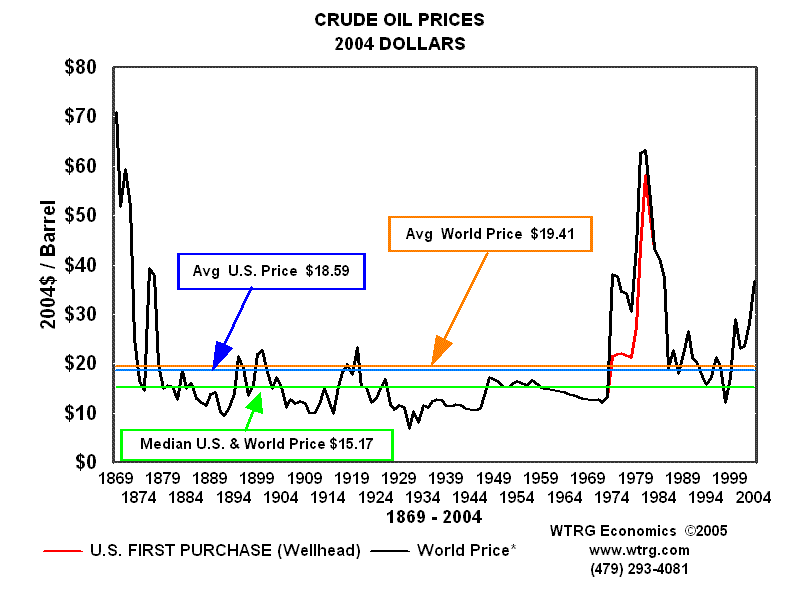
U.S. energy is generated primarily from coal, oil, and natural gas. Coal prices have remained relatively stable, but natural gas and oil have become significantly more expensive over the past ten years.

Price of oil in 2006 USD: http://www.wtrg.com/oil_graphs/oilprice1869.gif

Price of natural gas in 2006 USD:

The price of oil has increased by ~200% from 1999 to 2007, while the cost of natural gas has increased ~300% over that same time span.

Despite these price increases, the real U.S. GDP has risen by about 20% since 1999.

U.S. GDP: http://www.measuringworth.com/datasets/usgdp/result.php

If we presume that the U.S. as a whole is getting less energy per dollar, yet the GDP is still increasing, we can assume that the U.S. as a whole is increasing production per dollar of energy at least over the past ten years.

Thus, we could conclude that aggregate U.S. energy efficiency is increasing, not remaining stagnant.

We could also make an anecdotal “analysis” and note the large increase of emphasis on “energy efficiency” and “Green” efforts. Energy efficiency is increasing in everything from car mileage, to washing machines, to lightbulbs, to factories. This too would seem to refute Mr. Hill’s conclusion that energy efficiency has remained stagnant, at least in the U.S…

This brief analysis is not exhaustive and irrefutably conclusive, but it does illustrate that Mr. Hill’s conclusion might require a bit more explaining before we take it on faith as true.

Speaking of peak oil, it would also seem reasonable to conclude that oil companies would be an effective ‘canary in the mine-shaft’, since they are who would lose out the most if the world was running out of oil.

If the world’s oil supply was becoming rather scarce, it would be likely that oil companies would be scrambling hand over fist to be the first to market with a viable alternative fuel. Because if they didn’t, they would die.

Currently, most oil companies are instead treating alternative fuel research as a PR move, or a ‘lottery-ticket’ type investment.

Why then should we listen to chicken littles when the oil companies – who are putting their money where their mouth is – are predicting sufficient oil supply, at least in the mid-term?

[quote]tGunslinger wrote:
Why then should we listen to chicken littles when the oil companies – who are putting their money where their mouth is – are predicting sufficient oil supply, at least in the mid-term?[/quote]

Hum…then I guess king Abdallah of Saudi Arabia was lying in 1998 when he told the nation that “the oil boom is over and will not return… All of us must get used to a different lifestyle.”

And I also suppose you aren’t worried about the deforestation of the Amazon either. Seeing how timber companies aren’t planting trees over there…

Seriously mate, do you expect shareholders in oil companies to sit tight as the latter announce running out of oil soon?

[quote]Gael wrote:
I recently attended a seminar held by Charles Hall about Peak Oil.

Among many points raised, he argued that one of the central tenets of economics is wrong – that markets encourage efficiency and drive out inefficiency. He argued that the ultimate measure of efficiency of an economy is the ratio of energy consumption to GDP. If this ratio decreases with time, the economy has become more efficient. He then examined at the economies of some 30 countries, industrialized and non industrialized including the USA, and found that this ratio has not changed significantly with time. Thus, while our standards of living have gone up substantially, it is due to increased oil consumption, not increased market efficiency.

This was the most shocking point to me, and I was trying to figure out whether it is correct or not. After the presentation, he entertained criticism audience. There were many ecologists, scientists and economists there, but I was disappointed that no one addressed this particular point.

Let us assume that his numbers are correct. Does his conclusion follow?[/quote]

Efficiency used in economic terms means economic efficiency. If energy is not a decisive factor why should companies work towards energy efficiency?

Meaning, his assumption that markets automatically have to force companies to be more energy efficient would be only true if the price of energy rose significantly.

[quote]lixy wrote:
tGunslinger wrote:
Why then should we listen to chicken littles when the oil companies – who are putting their money where their mouth is – are predicting sufficient oil supply, at least in the mid-term?

Hum…then I guess king Abdallah of Saudi Arabia was lying in 1998 when he told the nation that “the oil boom is over and will not return… All of us must get used to a different lifestyle.”
…[/quote]

And we know how truthful the Saudi royal family is. They seem to be making more money on oil than ever.

[quote]lixy wrote:
tGunslinger wrote:
Why then should we listen to chicken littles when the oil companies – who are putting their money where their mouth is – are predicting sufficient oil supply, at least in the mid-term?

Hum…then I guess king Abdallah of Saudi Arabia was lying in 1998 when he told the nation that “the oil boom is over and will not return… All of us must get used to a different lifestyle.”

And I also suppose you aren’t worried about the deforestation of the Amazon either. Seeing how timber companies aren’t planting trees over there…

Seriously mate, do you expect shareholders in oil companies to sit tight as the latter announce running out of oil soon?[/quote]

If King Abdallah told me the sky was blue, I wouldn’t believe it.

I’m much more worried about the Arabization of the world through Saudi jihad exportation than I am the deforestation of the Amazon…

[quote]Zap Branigan wrote:
lixy wrote:
tGunslinger wrote:
Why then should we listen to chicken littles when the oil companies – who are putting their money where their mouth is – are predicting sufficient oil supply, at least in the mid-term?

Hum…then I guess king Abdallah of Saudi Arabia was lying in 1998 when he told the nation that “the oil boom is over and will not return… All of us must get used to a different lifestyle.”

And we know how truthful the Saudi royal family is. They seem to be making more money on oil than ever.[/quote]

tGunslinger wrote that we should only listen to people who have stakes in the oil business. King Abdallah’s quote seemed appropriate.

And if the Al-Sauds are making money over fist, it is thanks to Washington’s belligerence vis-a-vis Tehran, Caracas, and its invasion of Iraq. You know whom to bitchslap to the day a bunch of pissed-off Saudis finance yet another terrorist attack…

[quote]lixy wrote:
Hum…then I guess king Abdallah of Saudi Arabia was lying in 1998 when he told the nation that “the oil boom is over and will not return… All of us must get used to a different lifestyle.”[/quote]

He was either lying or he was stupid. Take your pick.

This has what to do with the topic at hand, exactly?

Did I say that?

Oil companies would no doubt take a market hit if they gave shareholders a reason to believe that the world is running out of oil. That’s why they do their very best not to prematurely exacerbate these concerns.

But at the same time, if oil companies really, truly believed down to their very bones that the world was running out of oil, don’t you think they would make a strong effort to diversify their operations and/or find a viable alternative fuel, regardless of the effect such actions would have on shareholders?

Because oil companies have the most money staked on the continued viability of oil, their actions are the most reliable indicators of the continued supply of oil. That’s why I called them the canary in the mineshaft.

When oil companies start acting funny, I’ll believe that oil is running low. But thus far, they’re not.

[quote]lixy wrote:
tGunslinger wrote that we should only listen to people who have stakes in the oil business. King Abdallah’s quote seemed appropriate.[/quote]

tGunslinger wrote that people should watch the actions of oil companies when trying to determine if the remaining worldwide oil supply is running low.

tGunslinger did not write that everyone should believe everything oil companies say about oil.

lixy, why do I even bother with you?

[quote]lixy wrote:

And I also suppose you aren’t worried about the deforestation of the Amazon either. Seeing how timber companies aren’t planting trees over there…

…[/quote]

I am trying to wrap my head around this one. Much Amazon deforestation is slash and burn for land use, not like the timber industry in the US. Why would you clear and burn a field just to replant?

I wonder how much rainforest is being destroyed to plant sugar cane to make ethanol to power cars in Brazil?