I’m 36 and married ED is an issue with us. So what should I do to get myself in check. Asking as my doc is not helping
Have you ever checked your E2 levels with both tests?
What do you mean ?
The Roche ECLIA methodology always reads higher than the sensitive and I have seen the same result from other men for years now and every now and again you see someone who is testing higher on the sensitive which is either a lab error.
So many men have rerun their labs to find estrogen lower than the ECLIA method, but for this to happen it has to be above ranges as that’s seems to be where the inaccuracies show up.
I’m all for doing things right the first so we don’t have to repeat labs and play roulette.
E2 levels in children, postmenopausal women, and men are much lower than in women of reproductive age. The increased sensitivity and specificity that are achieved by LC/MS-MS are the more appropriate choice for these clinical situations than the electrochemiluminescence immunoassay (ECLIA) method.1,2 See Estradiol, Sensitive, LC/MS [140244]. LC/MS-MS offers superior analytical sensitivity, specificity and a larger dynamic range than immunoassays.1 The clinical applications benefiting from highly sensitive E2 measurement include the assessment of congenital defects in sex steroid metabolism and disorders of puberty. This sensitive assay also has application in the evaluation of estrogen deficiency in men and menopausal women, fracture risk assessment in these populations, and increasingly, in therapeutic drug monitoring of low-dose female hormone replacement therapy or antiestrogen treatment.
Estradiol levels tend to fluctuate dramatically during the perimenopausal transition. There is significant overlap of the expected range in menopausal women with values observed during normal menstrual cycles. Estradiol results obtained with different assay methods cannot be used interchangeably in serial testing. To monitor a patient’s serial results, it is best to ensure that the same methodology is used each time the test is performed.
Understood, my question was have you ever checked your E2 levels with both tests, same sample?
No not yet
Have you ever had E2 checked with both methods?
As you can see from results I posted, ECLIA method does not always read higher than the LC/MS/MS test. If there is lab error, it is likely the LC/MS/MS method.
I spoke to a researcher for a major pharmaceutical company, Pfizer. She actually utilizes both methods, daily. She stated the IA is more reliable, with LC/MS equipment more complicated and has higher operator error. Yes, IA can pick up other steroid metabolites, and be effected if there is an inflammatory state, evidenced by a high ESR or CRP. Outliers, however, in TRT guys.
I was also able to speak to a doctor at Quest. He confirmed the above, but stated the sensitive test is designed to pick up E2 below levels measured by IA. With Quest, that is <15 which is what some may have seen on their lab reports. The test is for those expected to have very low (<15) E2 levels, menopausal women, some men, pre-pubescent children. If you are in the 20s and up, you’re fine. If you are expected to be below 15, and you need to know if you are at 1 or 14, the LC/MS/MS test is indicated. He believed IA results in the 20s and 30s would be accurate. I asked him which test is recommended and his words were “I’m on the fence”. The corporate arm of Quest would certainly recommend the more expensive test.
Many doctors are managing men just fine with IA testing. It appears any differences in the two tests are usually clinically insignificant.
As an aside, since reading @physioLogik here, I have dropped anastrozole. I feel better overall, but my joints feel better and a yearly PE with the PCP revealed a lipid profile better that ever, much better. Something for guys to consider, estrogen is cardioprotective. That and bone health are something to keep in mind.
Last, I’ve mentioned competing in weightlifting for many years in the days when there were no AIs available. Anabolic steroid and testosterone dosing compared to TRT was high, most used 400-800mg test a week. While yes, I knew some guys who experienced gyno symptoms and even had surgery for it, the vast majority had no difficulty with E2. I had morning sickness once.
I think many of the guys here are right, E2 is usually not a problem, even rarely a problem and aromatase inhibitors can be risky, you have confirmed it. I realize E2 is an issue for you, and why, but it appears we should rely more on how we feel vs. a lab number.
2 Likes
I have tested both together and the differences were as stated, ECLIA was always much higher than the LC/MS method and I see this a lot on all of the forums as well. Dr. Crisler as well as many other hormone experts agree that the ECLIA method is not as accurate as the LC/MS and Labcorp, the 800 pound gorilla says so as well.
I’m not going to go by a lab technicians word when Labcorp and all the expert hormone doctors are saying the ECLIA overstates E2 in men when E2 elevated. ECLIA was designed for women plain and simple, the LC/MS is designed for men and is more sensitive.
If you got a different result you are either a genetic anomaly or it’s a lab error which I have seen a lot with men using Lab Quest’s ultrasensitive.
Would you post those results please? I find this interesting. I would especially like to see examples where any differences would impact treatment protocols. Thanks.
I’m a genetic abnormality alright…but it’s not “if” I got a different result, I did and I can prove it. Please look at the labs I’ve posted. Regarding John Crisler, there are experts that disagree with him. I do think a PhD researcher that actually operates the equipment brings some credibility to the discussion. Plus, an MD working for Quest would seem to have a valid opinion. Not sure if Quest uses different equipment than LabCorp though.
We can disagree. I think it is fair that we go with our own experiences, but I do not think it is fair to say one method is the wrong test, especially when guys here are freaking out when they cannot get the sensitive test. And, you are not correct
when you say this:
“The Roche ECLIA methodology always reads higher than the sensitive”
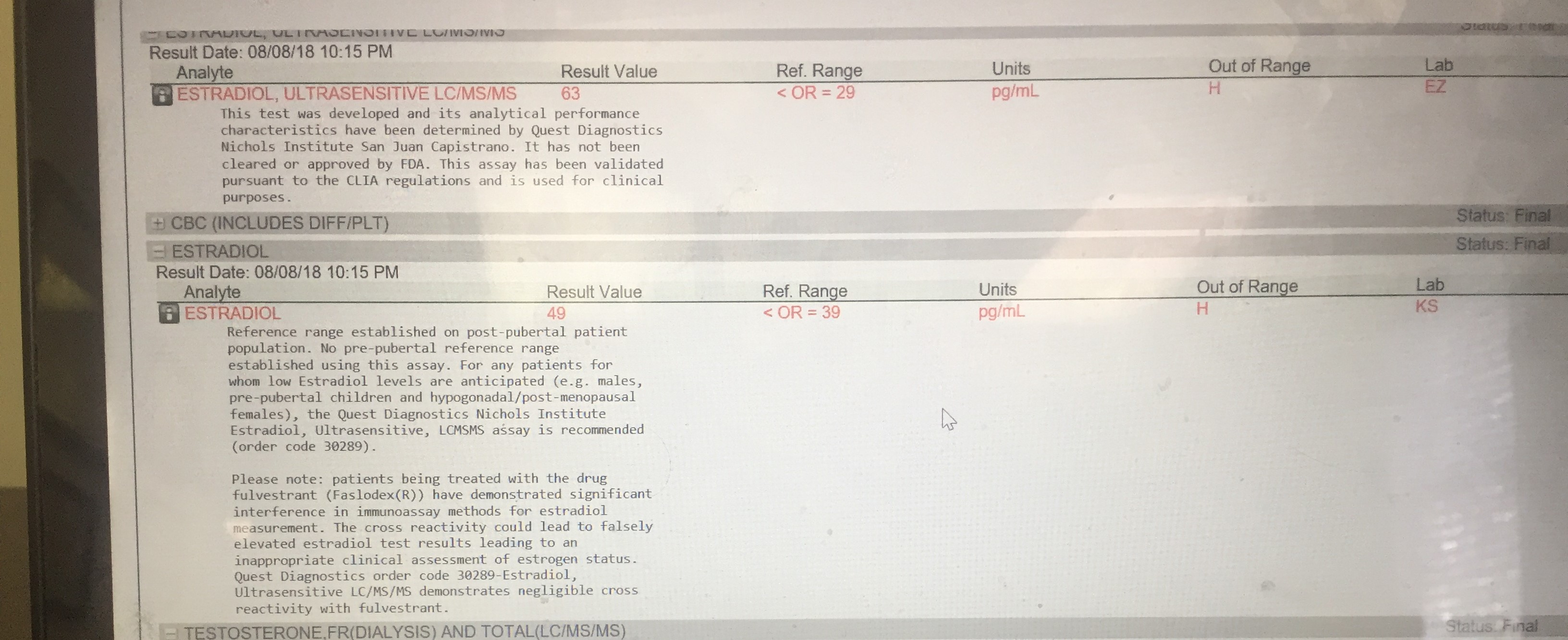
It simply is not true. I’ve seen others post results in which LC/MS/MS was higher, but not significantly so. Again, please, post some of the results that you have. I’m open to changing my mind.
I spoke with a lab supervisor at Bioreference regarding the eia v lcms testosterone test and he said that if levels are not low that eia is fine to use and no need for lcms.
And I do agree that sensitive test is subject to lab error way more so than eia method.
May be able to say the same with the e2 test.
Here’s a test


This from Bioreference @highpull so would I say I crashed with e2 lcms less then 5 but eia has 23? Also I believe when I spoke with lab supervisor he says that estradiol was all estrogens and the e2 one was just the e2???


2 Likes
Very interesting, that supports the argument of IA being higher than LC/MS/MS testing. But, if it (estradiol IA) is inclusive of estrone, estriol and other metabolites then it would be expected to be higher than E2 only.
On the other hand, LabCorp has the sensitive higher (37.4 to 33.1).
Thanks for posting that.
That is consistent with what I have been told regarding E2 testing.
Look at the test directory at Bioreference and see if you can figure out if the estradiol eia test it all estrogens. That means lab corp does differently or they have a different test.
We need to know this.
Reading LabCorp test menu seems clear that they both test e2 but one with eia and other sensitive with lcms.
Do you mean Quest’s LC/MS/MS testing is often incorrect, and reads higher E2 levels than actually present?
Will do. Quest is the same as LabCorp, both tests are E2. Thanks again.
Dude I thought I crashed. I mean I felt my e2 low but if Bioreference test called estradiol is all estrogens and that was 23 and the e2 portion was less than 5…idk
I just took the tests at LabCorp last week after the Bioreference labs. We will see what those numbers are but that’s after I stopped zinc.
If we were to take a poll, you know full well the outcome would be more men show overstated E2 levels on the ECLIA method which you can’t argue.
One set of labs is hardly proof of anything and I find it hard to hang my hat one one lab test and the word of someone lab tech.
Next time I run E2 I will do both the LC/MS/MS and ECLIA method.
I do not know that, which is why I would like to see your tests. Please post them.
I have other examples.
Please, I said she is a PhD researcher. Hardly a lab tech.
Great, me too. Thanks.