Same in my case, but I have heard people say the opposite too, not sure the validity because by far majority seems to sway towards sensitive being lower value than non sensitive.
1 Like


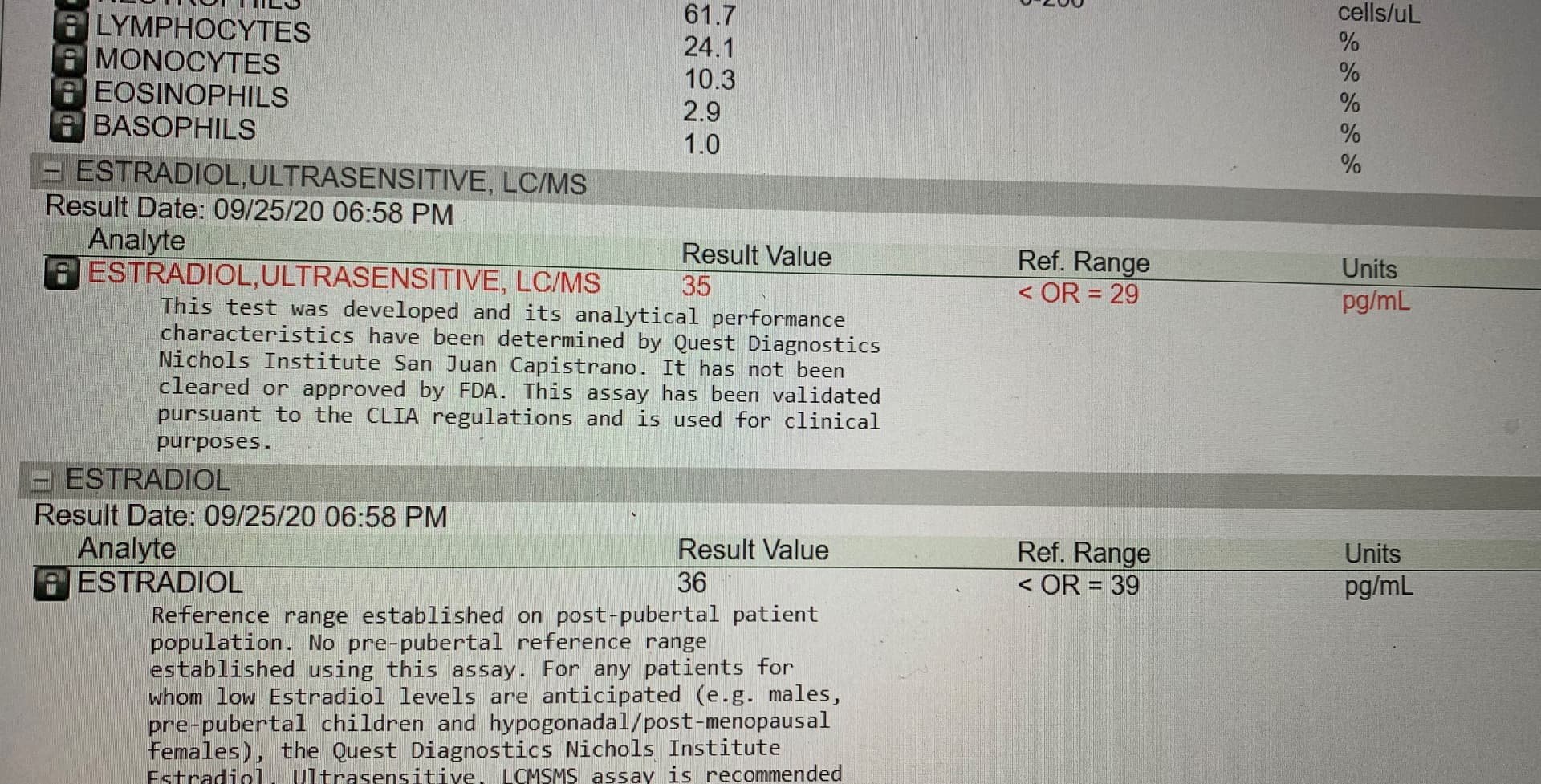


Yeah, the study you did has more. When I order tests out of my own curiosity, like the ultrasensitive E2 above, I pay for those, not the patient. I’m not paying for 3175 tests. I probably ordered both a couple, maybe three, dozen times, which provided enough information for my purpose.
1 Like
I know, I’m not messing with a scientist.
He made you pay for both?
I see. We do not bill insurance.
How did your tests compare?
1 Like
For my next blood work I will get normal, sensitive, and ultra sensitive out of curiosity.
Not sure maybe I am wrong but I could have sworn I seen both offered on blood work.
Also the ref ranges seem to be different for the 2 as well.
ECLIA vs LC/MS/MS TESTING FOR E2
The ECLIA test (aka immunoassay or IA) for E2 management is commonly used for those on TRT. It is not an incorrect test or a test for women, but simply one way to check estradiol levels. The other commonly utilized test is the LC/MS/MS method (aka liquid chromatography dual mass spectrometry, sensitive or ultrasensitive). It is the more expensive of the two. There are inherent advantages and disadvantages to each of these two methods. I have been fortunate to be able to speak with professionals who work with both methods. One is a PhD researcher for Pfizer and the other is a medical doctor at Quest. I’ll summarize their comments.
The ECLIA method is the more reliable of the two in terms of consistent results. The equipment is easier to operate thus accuracy is less reliant on the skill of the operator. If the same sample were to be tested twenty times, there would be very little, if any, difference in the results.
The ECLIA method is not as “sensitive” in that it will not pick up E2 levels below 15pg/mL. If your E2 level with this test is 1-14pg/mL, the reported result will be “<15”. Because of this, it is not recommended for menopausal women, men in whom very low levels of E2 are suspected, or children. In other words, if your levels are below 15pg/mL, and it is important to know if the level is 1 or 14pg/mL, you do not want this test. For us, this is likely moot, since if you are experiencing low E2 symptoms and your test comes back at <15, you have your answer. For a woman being treated with anti-estrogen therapy for breast cancer, it may be necessary to know if the E2 level is zero or fourteen because therapeutically, they want zero estrogen.
A disadvantage to IA testing is that it may pick up other steroid metabolites, which in men would be very low levels, but still could alter the result. Another potential disadvantage is that elevated levels of C-reactive protein (CRP) may elevate the result. CRP is elevated in serious infections, cancer, auto-immune diseases, like rheumatoid arthritis and other rheumatoid diseases, cardiovascular disease and morbid obesity. Even birth control pills could increase CRP. A normal CRP level is 0-5 to 10mg/L. In the referenced illnesses, CRP can go over 100, or even over 200mg/L. Unless battling one of these serious conditions, CRP interference is unlikely.
The LC/MS/MS method will pick up lower E2 levels and would be indicated in menopausal women and some men if very low E2 levels are suspected and it is desired to know exactly how low, children and the previously mentioned women on anti-estrogen therapy. It will not be influenced by elevated CRP levels or other steroid metabolites.
While some may believe the ECLIA test is for women, on the contrary, as it pertains to women on anti-estrogen therapy, such as breast cancer patients, the LC/MS/MS is the test for women as CRP levels are a consideration and it is necessary to know if the treatment has achieved an estrogen level of zero.
On the other side of the coin, LC/MS/MS equipment is “temperamental” (as stated by the PhD who operates both) and results are more likely to be inconsistent. Because of this, researchers will often run the same sample multiple times.
It is not clear if FDA approval is significant, but this appears on Quest’s lab reports: This test was developed, and its analytical performance characteristics have been determined by Quest Diagnostics Nichols Institute San Juan Capistrano. It has not been cleared or approved by FDA. This assay has been validated pursuant to the CLIA regulations and is used for clinical purposes. This statement is on LabCorp’s results: This test was developed and its performance characteristics determined by LabCorp. It has not been cleared by the Food and Drug Administration.
It is unlikely that any difference in the same sample run through both methods will be clinically significant. Estradiol must be evaluated, and it should be checked initially and ongoing after starting TRT. It obviously makes sense to use the same method throughout. Most important are previous history and symptoms related to low or high E2. Those are correlated with before and after lab results. Any estradiol management should not be utilized without symptoms confirmed by lab results.
4 Likes
@highpull, IIRC, uses the standard E2 test on his patients.
That is correct.
After I posted my comment, I then saw your post regarding ECLIA vs LC/MS/MS estradiol testing. It was an excellent, informative read.
From the day I started testosterone injections, all I read on forums was that you MUST get the ultrasensitive E2 test; that the standard test won’t accurately reflect your estradiol level. I’m on Medicare and my urologist has been fine with ordering that test.
What I see are three schools of thought; 1)Only the ultrasensitive test and managing E2. 2) The standard test is fine, the deviation not being critical 3) Dr. Rouzier and those he’s mentored; not controlling E2 and even prescribing estradiol to some patients to increase their E2 in order to improve lipids and erectile function. Even for a well informed patient who still is struggling, it can be confusing and overwhelming.
3 Likes
Out of how many patients do you see higher sensitive than none? I know they exist as I said but reading around and seeing anecdote they assumption has always been majority (> 50%) usually goes the other way
You’re learning as much as you can. Good for you.
To my way of thinking, it’s not about the difference between the two methods (though that is the position some will take), it’s about changing levels. As long as you are not paying extra for the LC/MS/MS, fine.
I did not test many, just enough to satisfy my curiosity. It seemed that the higher the levels, the more likely the LC/MS/MS would be significantly higher than the IA. Levels around 20-30 were fairly similar, any difference was not significant.
Thank you.
Bumped to 150 mg & 0.125 mg anastrazole. I went up on T because I was experiencing more depression and sadness. Some or all of it is situational. My wife has worsening dementia. I have to stay healthy. Did 100 push ups this morning, after hitting the wall at 90 on 100 mg, weekly… 140 squeezes on my hand grips. This energy/stamina increase might be temporary. I didn’t have a restful sleep so I know I’m feeling better from the increase in testosterone.
Interesting you say this. My doc prescribed 0.3mg sustain E/4D. I didn’t feel well. Hot flashes and being tired was the most sides. I changed for test Cyp same frequency and I’m gold. I guess everyone is different. 0.5mg E5D was my sweet spot but I lost hair so I’m trying to figure if more frequency works better for DHT.
1 Like
If it is already gone, I wouldn’t worry too much about DHT. If it is mild, there are things that work very well for retaining hair, or growing some back.
1 Like
Thank you. Yeah trying minoxydil and some shampoos. Still have hope 
What are you suggesting?
1 Like
Imo, the most effective treatment that is approved for hair loss in the US is finasteride. It blocks conversion of testosterone to DHT (about 70 percent). There is a chance of lower libido and erectile dysfunction in about 5 percent of guys. Those side effects typically go away if you stop taking it, in under a month. There are some reports of ongoing issues after stopping it. I haven’t seen research proving it though. Imo, the group of people using finasteride are kinda the group that is prone to develop ED, or lower libido on their own. The data out there shows that the amount of people that develop these sides after stopping finasteride are around the same as developing it just due to age or unknown factors.
Studies show it’s pretty good at maintaining hair as it is when starting the drug. They have 10 year data showing this. Some men improved their hair.
Other than that, there is research showing minoxidil is effective. The topical (rogain), has about 40 percent that had good regrowth on it. Some just maintain, and some it slows down the loss or doesn’t do much. I take a pill version. It works for a lot more people than the topical. There are serious side effects with the oral version, and it is off label in the US. It isn’t uncommon for dermatologists to rx it for hair loss in the US though). Imo, this risk comes down to the dosage. The drug was a blood pressure drug to start out with. I’m taking about 1/4 the starting dose for men (2.5 mg). I’m thinking of dropping down to 1.25 mg/day once I run out of the 10 mg tabs that I quarter. I wouldn’t go higher than that. Do your research if you consider. Do the research some more after that.
Oral or the topical minoxidil are where you get regrowth (new thick hairs). It’s not as great at preventing loss as finasteride though. You need to be on it if you want it to keep working though. If you stop taking it the hairs grown with it will be lost.
1 Like