So I got to thinking today, of all my time spent with film, what are the defining moments to me. When every memory I have is splayed out onto the table, what are the things I will pick out above all else and regard to be the most unique, most influential, most deeply resonant experiences I’ve come across so far. In honour of that, and the subsequent thought process and mental journey I had to discover why some of these things ignited my love for cinema, I’d like to create a thread about all of our favourite scenes we will cherish for each of our remaining years to come. With the rising interest in film-related threads on the forums, this seems the perfect time to bring this to attention.
As a disclaimer, this is not to mean what you believe are the greatest scenes in film, but your personal favourites. If you should pick something unpredicted and maybe even slightly unorthodox from an analytical perspective, I would love to hear you expand on your emotional reasons for choosing said particular scene, so that we may have a chance to understand your reasoning and see the beauty in it for ourselves.

The first of mine is from Cool Hand Luke, after the death of Luke’s mother. I adore this scene largely because of how it relates to the context of the story so far. (Spoilers.) Luke’s mother has just died a little while after visiting him in prison, and he hears of it indirectly, but can’t leave the prison to go to her funeral. So he picks up a banjo his mother left for him, walks over to his bunk, and the scene begins. The song “Plastic Jesus” is a comedic religious satire, but Newman’s slow and somber interpretation of this transforms it into something beautiful and poetic, a respectful and glorious way for Luke to mourn the passing of his mother. His voided stare and the appearance of a tear streaming down Newman’s cheek is powerful and deeply saddening, it shows the extraordinary remorse of his character and the powerful feeling of having lost someone he loved above most all others. The choice of song is incredible if just for it’s final line in the scene “…assuring me that I won’t go to hell” is a direct reflection to me of how Luke’s morals and kindness is just, and that even though he’s in prison and the societal perspective sees him as a bad apple, he knows deep inside that he’s a good person, and that his mother knew that of him as well. All around this is a very powerful scene and one that will stay with me for a very, very long time.
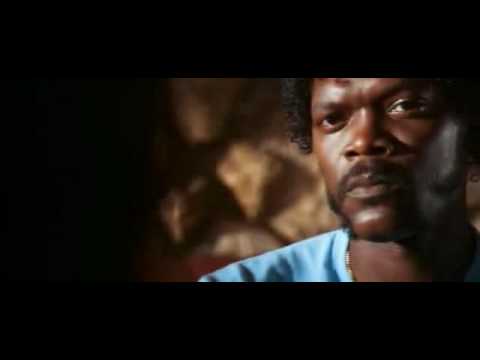
The second is my favourite scene from my favourite film, the Bible scene in the Diner at the end of Pulp Fiction. Even though the story is scattered apart and the chronology is made to be different, the message behind the film culminates gradually until it ends with this, a perfect representation of the defining theme so far. Jules’ bible passage is one of the coolest and most well-known quotes in modern cinema, but to take it further like this is incredible. The way Jules expands on the passage, to show us something beyond what we’d already seen of it, and make it fit on the frontline of the film itself, is perhaps the most incredibly meaningful scenes of the entire film. It shows that over time Jules has found meaning and a respect for the passage beyond it’s origins (origins as they relate to him) and that he acknowledges the bad inside of him and surrounding his actions, but it is still upon him to make a difference for the greater good. The line “But I’m trying real hard to be the shepherd” shows the inner conflict of Jules’ character and his ambition to make up for the wrongdoings of his past, and repay the debt he feels he owes to the world. It shows that in sparing Roth’s character, Jules is taking it upon himself to transform, and transcend the moral flaws of his humanity. I’m an atheist by nature and I plan to be for a very long time, but if there is anything that has led me to respect and understand The Bible for what it really means down to it’s core, it is this scene.

Sadly I can’t find the exact scene I’m going to be talking about, because youtube does not have it under an english title, and I don’t speak Japanese, so I can’t find it if it’s under that. But what I will be referencing is the final scene of the film.
I have to thank Cortes for introducing me to Tokyo Story, a film which I now believe to be one of , if not the, greatest film of all time. (Spoilers) The ending culminates with the death of the grandmother in the centralised family of the film, and is the beginning of the unity between all family members under a common, shared interest for the first time in a long time. In particular is the dialogue between the grandparents youngest daughter, Kyoko, and their now widowed daughter-in-law, Noriko. Kyoko utters the phrase “Isn’t life disappointing?” once they begin to reminisce about the selfishness and inhumane tendencies of some of their family members. It was made clear to me that even though the family was united through death, that the dismissal and neglect that came before it is still fervently present. It shows that we must all cherish and care for life and our loved ones, lest we reflect back on life and be aware of the disappointment we may have so easily fallen under, and been corrupted by. Regardless of who you are, this film and scene are applicable to you, and I implore you to see it, because I am sure it will be a memory that will cling to you too.

The Coin Toss scene in the gas station in No Country For Old Men is an incredibly ominous scene, and perhaps the most terrifying from dialogue alone. Anton Chigurh is one of my all time favourite villains in cinema, and this scene stands to be the most obvious reason why. The maniacal character of Chigurh heads into a gas station for something as simple as paying for gas, and on the whim of something the owner says, he begins a dark, chilling interrogation of him leading Chigurh to contemplate whether the man deserves his life. The verbosity and blunt characteristics of Chigurh’s dialogue here in response to the station owner’s is brutal in every sense of the word. There are many parts of this scene that stand out to me, when we realise Chigurh feels the need to test the owner’s gratefulness for life, when Chigurh starts to feel contempt for the way the man has lived and feels he has leeched off of his wife’s family’s hard earned pleasures, when the owner starts to realise the gravity of the situation and the kind of man he is facing, and the scene where he finally decides to make the man wager his life to a game of random chance. But most of all, the frightening contrast in Chigurh after the owner wins the coin toss, and reverts to his kind and nonchalant personality, the ending dialogue about the importance of the coin relative to the rest of the scene sends shivers down my spine each and every time.

Finally is perhaps my favourite scene of all time, the opening sequence to Scorsese’s Raging Bull. Everything about this scene is mesmerizing, the shot never moves, the location never changes, and the only thing constantly in motion for the entire scene is De Niro himself. It’s accompanied by a deep and sorrowful score, as we look in on De Niro as LaMotta shadowboxing in the ring. As someone that grew up boxing through childhood, I always saw something in this scene that would play in the front of my mind throughout the whole film, the idea that De Niro is in the ring, surrounded on the outside by an entire crowd of individuals all cheering and watching him, but inside the ring is a vivid sense of loneliness and poetic tranquility, despite the context of boxing as it is present. This fully represents LaMotta as he is portrayed all the way through Raging Bull, that no matter what, he is never able to share himself and his emotions easily, or to feel he can be truthful and respected by others, even his own brother. The first time you watch the film, and see this opening scene, you will find it beautiful. The second time you see the film, and every subsequent time you see it, it will tear you to ruin and bring you to tears. I believe this scene to be atop the pinnacle of cinematic artistry, a flawless and pristine interpretation of beauty and grace.
There are some honourable mentions, the “Tears In Rain” scene from Blade Runner, some of the scenes from Anderson’s There Will Be Blood, Annie Hall and The Godfather, but including them would make this post obnoxiously long. If this thread picks up speed and shows a lot of promise, I may include all of those further down the line.


