Health Care - What Should Happen?

Maybe when some of you get a bit older you’ll realize that people get sick and die of things even if they live a perfect life.

Or, you might find that people who were born 60 years ago or more didn’t realize that paint fumes or shoveling coal into furnaces was going to destroy their lungs… nor were there health regulations to protect them.

Also, when I was young and still in school, even then I understood that once you have a family you are vulnerable. I guess nobody who isn’t a millionaire should have a child… in case there are complications.

If some of you turkeys could look a little further than pure ideology you’d see that there are realities of life that cause the creation of society… to provide for a secure and stable environment for the majority of the populace.

It’s easy to be an island when you are a young man… everyone else is left to live on a knife edge.

Thump your chest and claim “dog eat dog” and so on if you want, until very recently it was quite clear the populace didn’t want that. Nation against nation, warfare, ignorance, disease, depravity, these are things that civilized society would like to reduce.

[quote]vroom wrote:
Maybe when some of you get a bit older you’ll realize that people get sick and die of things even if they live a perfect life.
[/quote]

Funny, the day I realized that I got private health insurance.

[quote]

Thump your chest and claim “dog eat dog” and so on if you want, until very recently it was quite clear the populace didn’t want that. Nation against nation, warfare, ignorance, disease, depravity, these are things that civilized society would like to reduce.[/quote]

I agree.

That is why I am adamantly against turning a republic into a dog eat dog society where everyone wants to be in control of the government to be able to steal from everyone else.

I am also very much for taking the means away from states to start unnecessary wars and for stopping the depravity of involuntary servitude that is necessary for a public health service to work.

Take a close look at what people in a universal healthcare setting need to do for care. Wether it is preventative, organ transplant, common cold, therapy, whatever. Then decide what u think of it.

[quote]kaaleppi wrote:
Sloth wrote:
Preventative care shouldn’t cost us anything. Nor should care after the fact. Instead, preventative care and regular care should cost the individual. That’s cool if you want to shoot heroin, eat pizza and drink cola everyday, and smoke a pack a cigs before getting your 4 of sleep for the night. We’re just not going to pay for it.

Between subsidizing someone else’s healthcare and not, I bet not doing so results in a society much more aware of what the hell they’re doing to their bodies.

I don’t think history is on your side on this, Sloth. Public healthcare wont change it, either. To pay or not, that’s more of an ideological question.[/quote]

I disagree. If an individual had to pay for his or her healthcare out of pocket people would be more health conscious. Look at me for example. I eat health and spend roughly $80+ a month on vitamins, fish oil, protein, etc… Plus another $35 a month on a gym membership. I also haven’t been to the doctor is years other then a yearly physical.

The insurance company is making a killing off my premium each month, but at the same time someone who watches TV 5 hours a day and goes to the doctor when they have a bruise is costing thousands of dollars in insurance money. There should at least be incentives for those of us that take care of ourselves.

[quote]engerland66 wrote:
I am a first-year medical student, so this a very pertinent topic for me and my fellow classmates. The vast majority of them are Obama supporters and are in favor of a more socialized/government-involved set-up to current healthcare.

I know I butchered the soc/gov-inv. part but I don’t know how else to describe Obama’s plans. He wants to take tax cuts from the rich (meaning they pay less of the vast majority of taxes) and use it to pay for insurance for the poorest (which, I believe, is a socialist principle).

On the other hand, he says those who like their current plans do not have to change (I’m not sure how valid this claim will be once the added citizens will be added to the pot). I don’t see how adding millions of patients to the system will not change things. Especially since the number of doctors is not changing in any significant way, which is something nobody is talking about.

From a logical standpoint, it seems that one’s primary care will not change as long as your family physician is not taking on tons of new patients. However, for those patients that become very sick and are within striking distance of a teaching hospital, I do not see how your care will remain the same. Since this teaching hospital is most likely located within a city full of newly qualified patients with increased access, why will your quality of care not change?

I am not so much challenging why these new patients should have coverage, but how we think patient care would not be compromised by such a plan?

The bottom line is, for those who have adequate care, how do you see your quality of care increasing under Obama?[/quote]

I see medical tourism booming under Obama and the economies of Thailand, India, Mexico, and China therefore benefiting.

Currently, the US government pays for 46% of all health care. The first Baby Boomer started collecting SS and Medicare as of January of this year. As this huge demographic starts collecting payments, the percentage should jump up drastically, probably gobbling up the entire US GDP without reforms.

With completely socialized care, doctors will get paid less, quality will go down, but so will costs. Pleasant dreams! Doctors, in general, are Marxists, so it will be interesting to watch Marxism affect their profession even more than it already has.
[quote]PRCalDude wrote:
engerland66 wrote:
I am a first-year medical student, so this a very pertinent topic for me and my fellow classmates. The vast majority of them are Obama supporters and are in favor of a more socialized/government-involved set-up to current healthcare.

I know I butchered the soc/gov-inv. part but I don’t know how else to describe Obama’s plans. He wants to take tax cuts from the rich (meaning they pay less of the vast majority of taxes) and use it to pay for insurance for the poorest (which, I believe, is a socialist principle).

On the other hand, he says those who like their current plans do not have to change (I’m not sure how valid this claim will be once the added citizens will be added to the pot). I don’t see how adding millions of patients to the system will not change things. Especially since the number of doctors is not changing in any significant way, which is something nobody is talking about.

From a logical standpoint, it seems that one’s primary care will not change as long as your family physician is not taking on tons of new patients. However, for those patients that become very sick and are within striking distance of a teaching hospital, I do not see how your care will remain the same. Since this teaching hospital is most likely located within a city full of newly qualified patients with increased access, why will your quality of care not change?

I am not so much challenging why these new patients should have coverage, but how we think patient care would not be compromised by such a plan?

The bottom line is, for those who have adequate care, how do you see your quality of care increasing under Obama?

Doctors, in general, are Marxists, so it will be interesting to watch Marxism affect their profession even more than it already has.
[/quote]

I agree with your medical tourism point. What do you mean by this, though? How are all doctors Marxists?

[quote]engerland66 wrote:
Headhunter wrote:
Lots of docs want out and are telling their kids to avoid medicine (saw a survey a couple of days ago).

Wait until your doc is paid $30,000 a year to start, and maxes out at about $60,000 after 30 years, you know, kind of like…public school teachers.

Won’t medicine be a shining star then!!!

The idea of becoming one step closer to a government employee bothers me a lot.[/quote]

Why would you require doctors to become a government employee? DO you think that doctors in the US are employees of the insurance companies?

[quote]usmccds423 wrote:

I disagree. If an individual had to pay for his or her healthcare out of pocket people would be more health conscious. Look at me for example. I eat health and spend roughly $80+ a month on vitamins, fish oil, protein, etc… Plus another $35 a month on a gym membership. I also haven’t been to the doctor is years other then a yearly physical.

The insurance company is making a killing off my premium each month, but at the same time someone who watches TV 5 hours a day and goes to the doctor when they have a bruise is costing thousands of dollars in insurance money. There should at least be incentives for those of us that take care of ourselves.[/quote]

If thats your take, you should look into getting a High Deductible Plan with a Health Savings Account. This year I had a low premium, my employer pumped $750 into the account, and my additional contributions are tax deductible. A very solid plan for those who are in good health and don’t see the doctor much (but be prepared if the shit hits the fan, cuz that will cost you).

[quote]Journeyman wrote:
engerland66 wrote:
Headhunter wrote:
Lots of docs want out and are telling their kids to avoid medicine (saw a survey a couple of days ago).

Wait until your doc is paid $30,000 a year to start, and maxes out at about $60,000 after 30 years, you know, kind of like…public school teachers.

Won’t medicine be a shining star then!!!

The idea of becoming one step closer to a government employee bothers me a lot.

Why would you require doctors to become a government employee? DO you think that doctors in the US are employees of the insurance companies?
[/quote]

Yepp, in order to be a covered provider they have to follow certain guidelines they might not otherwise chose to follow, that and the fact I would have to deal with fat slobs who want a pill and won’t do anything for themeselves are 2 reasons I did not go to med school.

I don’t feel healthcare is a right, it is a service. another one of those great american concepts that helps breed mediocracy genetic defects into our gene pool.

Not to say people shouldn’t care about others they should, but the government should not force it. They are far too inefficient.

[quote]Journeyman wrote:

Why would you require doctors to become a government employee? DO you think that doctors in the US are employees of the insurance companies?
[/quote]

Pretty much, yeah.
My father bitches about it all the time too.

[quote]Beowolf wrote:
Journeyman wrote:

Why would you require doctors to become a government employee? DO you think that doctors in the US are employees of the insurance companies?

Pretty much, yeah.
My father bitches about it all the time too.
[/quote]

I agree that the HMOs and insurers are interfering in the doctor/patient relationship. I honestly think that the French, Swiss and German health care systems are much less intrusive into the doctor/patient relationship. A well run system of universal health care must include care for this critical relationship.

[quote]apbt55 wrote:

Not to say people shouldn’t care about others they should, but the government should not force it. They are far too inefficient.[/quote]

But there simply is not empirical evidence for your assumption that government is less efficient. Who pays the most (per capita) for health care, the US or Western Europeans? Which system delivers better health? Our current system is one of the least efficient (economically) of any system in the world. From an economic perspective, our current system is a huge burden on our economy. We are competing with Europeans that have lower health care costs than we do. We are constantly seeing US companies, like the Big Three, that are unable to compete with foreign competitors. A significant component of this cost difference is the cost of providing health care coverage for employees. We need cost effective health care for or long term economic competitiveness. The empirical evidence is clear, universal health care is more efficient.

[quote]Journeyman wrote:
apbt55 wrote:

Not to say people shouldn’t care about others they should, but the government should not force it. They are far too inefficient.

But there simply is not empirical evidence for your assumption that government is less efficient. Who pays the most (per capita) for health care, the US or Western Europeans? Which system delivers better health? Our current system is one of the least efficient (economically) of any system in the world. From an economic perspective, our current system is a huge burden on our economy. We are competing with Europeans that have lower health care costs than we do. We are constantly seeing US companies, like the Big Three, that are unable to compete with foreign competitors. A significant component of this cost difference is the cost of providing health care coverage for employees. We need cost effective health care for or long term economic competitiveness. The empirical evidence is clear, universal health care is more efficient.[/quote]

a) The American society is much more violent than ours.

Take that into account and death rates are more or less the same.

b) We Europeans live above our means. Our health care system is built on promises that will never be kept.

Even if we had a small advantage now, what does it matter when our system is already collapsing?

[quote]orion wrote:
Journeyman wrote:
apbt55 wrote:

Not to say people shouldn’t care about others they should, but the government should not force it. They are far too inefficient.

But there simply is not empirical evidence for your assumption that government is less efficient. Who pays the most (per capita) for health care, the US or Western Europeans? Which system delivers better health? Our current system is one of the least efficient (economically) of any system in the world. From an economic perspective, our current system is a huge burden on our economy. We are competing with Europeans that have lower health care costs than we do. We are constantly seeing US companies, like the Big Three, that are unable to compete with foreign competitors. A significant component of this cost difference is the cost of providing health care coverage for employees. We need cost effective health care for or long term economic competitiveness. The empirical evidence is clear, universal health care is more efficient.

a) The American society is much more violent than ours.

Take that into account and death rates are more or less the same.

b) We Europeans live above our means. Our health care system is built on promises that will never be kept.

Even if we had a small advantage now, what does it matter when our system is already collapsing?

[/quote]
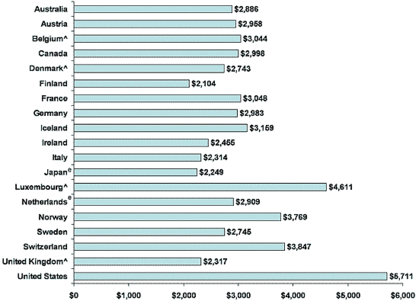
See http://www.kff.org/insurance/snapshot/chcm010307oth.cfm

As of 2003,
Austria spent $2959 per person on health care
The US spent $6711 per person.

Who is living beyond there means? I would argue that the US system is the one in greater danger of collapse.

Why force universal healthcare on us? Just get your own.

[quote]Sloth wrote:
Why force universal healthcare on us? Just get your own.[/quote]

Because it works better and saves us all money. Usually, markets are more efficient than central planning. But sometimes a collective response is more effective. The evidence seems pretty clear that health care is one of those cases where a collective response is better. Show me numbers where a free market approach to heath care works better. If we can get even better results than the European systems that are already working, then I’ll be happy to support a market solution.

[quote]Journeyman wrote:
If we can get even better results than the European systems that are already working, then I’ll be happy to support a market solution.[/quote]

When you compare the outcomes for specific
diseases, the United States clearly outperforms
the rest of the world. Whether the disease
is cancer, pneumonia, heart disease, or
AIDS, the chances of a patient surviving are far
higher in the United States than in other countries.
For example, according to a study published
in the British medical journal The Lancet,
the United States is at the top of the charts
when it comes to surviving cancer.

Among men, roughly 62.9 percent of those diagnosed
with cancer survive for at least five years. The
news is even better for women: the five year-survival
rate is 66.3 percent, or two-thirds. The
countries with the next best results are Iceland
for men (61.8 percent) and Sweden for women
(60.3 percent). Most countries with national
health care fare far worse.

For example, in Italy,59.7 percent of men and 49.8 percent of women survive five years. In Spain, just 59 percent
of men and 49.5 percent of women do.
And in Great Britain, a dismal 44.8 percent of
men and only a slightly better 52.7 percent of
women live for five years after diagnosis.26
Notably, when former Italian prime minister
Silvio Berlusconi needed heart surgery last
year, he didn?t go to a French, Canadian,
Cuban, or even Italian hospital?he went to the
Cleveland Clinic in Ohio.27

Likewise, Canadian MP Belinda Stronach had surgery for her breast cancer at a California hospital.28 Berlusconi and
Stronach were following in the footsteps of
tens of thousands of patients from around the
world who come to the United States for treatment
every year.

Concerning the often cited infant mortality rates.

Similarly, infant mortality, a common measure
in cross-country comparisons, is highly
problematic. In the United States, very low
birth-weight infants have a much greater
chance of being brought to term with the latest medical technologies. Some of those low birthweight babies die soon after birth, which boosts our infant mortality rate, but in many other Western countries, those high-risk, low birth-weight infants are not included when infant mortality is calculated.24 In addition, many countries use abortion to eliminate problem pregnancies.

For example, Michael Moore cites low infant mortality rates in Cuba, yet that country has one of the world?s highest abortion rates, meaning that many babies with health problems that could lead to early deaths are never brought to term.

And, before anyone mentions life expectancy rates, you have to factor in things like violence, diet and lifestyle, drug use, accident rates, etc for each country.

If one can use the force of government to make me responsible for the health of another, is the recipient of government enforced charity also held responsible to me? Can we prohibit cigarettes, fast food (or all unhealthy diets), anal sex, alcohol, contact sports, etc? Do we need to enforce national helmet, knee/elbow pad, and leather riding clothing laws? Well, should we even allow motorcyles, when a car might be safer?

Or, is this responsibility a one way deal? From me (though I don’t want to participate at all) to someone else?