
Robert Reich makes a much better argument than I.
Robert Reich makes a much better argument than I.
[quote]Zeppelin795 wrote:
Then where are the real studies and evidence?
[/quote]
What exactly is a “real” study?
I know for a fact the minimum wage increase in MD is going to cost the company I work for several million dollars annually. Fortunately we’re doing well and can afford it. For now.
[quote]usmccds423 wrote:
[quote]florelius wrote:
The data is that McDonalds, Burger king, Fridays and other American fast Food Companys operates in my country where they have to pay their workers alot more ( roughly 20-25 dollars an hour ), A worker here who Works fulltime( 40 hours a week ) at mcDonalds can pay rent, gas, buy the Essentials like Food clothes etc, get drunk once or twice a week and so on. If they where not able to generate a profit from being here, they would not be here. From that observation I atleast Draw the conclusion that they are able to pay People a decent wage in Your country. [/quote]
That’s not exactly data is it? How much do the products at these restaurants cost? What is your cost of living? Does the $20-$25 include benefits? What exactly is a decent wage anyway? How much support do these worker get from the government?
[quote]
When it comes too other bussines that are not able too pay People a more than the current minimum wage then you have too way the positives against the negatives. If an increase in the minimum wage leads to an overall effect of improving the lifes of people stuck in low-wage employment and increasing Growth in Your domestic market, then I will say that a few bancrupt company’s is Worth the cost. As they say, you have to break some eggs to make a omelett.[/quote]
My guess, and it is a guess (A somewhat educated one), is that the positives will not out weigh the negatives in this case. You are talking about a lot of companies across a lot of industries. We will either have an increase in those on government assistance because companies are out of business or we will have an increase in those on government assistance because even more jobs have been shipped over seas. Reducing the number of available jobs in America is not a solution to our problems. [/quote]
I am not saying that fewer jobs than is currently existing is a positive, but that if the overall effect is positive( as in lifting low-wage workers out of poverty, economic Growth/more jobs ) then it is acceptable that some individuals loses their jobs.
Regarding the argument I made based on the situation for fast-Food workers in Norway, I admitt that’s not stone Cold data. I should have said “based on my personal observation in my home counry” rather than data.
[quote]florelius wrote:
Robert Reich makes a much better argument than I.
[/quote]
Don’t take this personal because it’s not, but it’s going to take more than a 3 minute YouTube video to change most people’s minds that have even a basic understanding of business.
First of all why did Reich need to bring politics into the discussion at all? His arguments should be enough on their own.
He talks about how we subsidize some workers. Are those part time or full time minimum wage workers?
If the minimum wage is raised across the board via force by the government how does he know the additional cost would come from profits? I would think all of these highly competitive industries would all raise costs, which means A) the raise a small percentage just received won’t go as far and B) The rest of us will still be subsidizing the minimum wage worker, it’ll just be through sales not taxes (which honestly I’d prefer if an only if tax rates went down).
He talks about poverty quite a bit in that short video. I’d like to know how many people he’s actually talking about, their demographic information, etc… These numbers often include questionable groups (like college students) as those living in poverty.
Let’s see, what else did he talk about. Oh right, inflation and productivity. I would like to know where he gets this information. I’d like to know how he has accounted for the recession. I’d like to know how much, if not all, of the increased productivity he’s attributing to the worker. I’m sorry, but I have a hard time believing the increased profits due to increased productivity are attributable to minimum wage workers. Some of it should be attributed to workers, but I don’t think much of it is attributable to minimum wage workers. Taking a fast food order in 1960 and 2014 are not that different and in some ways it’s probably easier. I would also like to know how much the economy in general has grown over this 50 year period and how other costs have changed over the period as well. I think it’s easy to ignore how revolutionary technology like computer and internet have been for business.
[quote]florelius wrote:
Regarding the argument I made based on the situation for fast-Food workers in Norway, I admitt that’s not stone Cold data. I should have said “based on my personal observation in my home counry” rather than data. [/quote]
Well, I’m glad it works in Norway. I honestly hate having this discussion. It’s a very small percentage of workers and there are underlying problems that need to be addresses. Raising the minimum is like putting a band-aide over a gun shot wound in my opinion. The minimum wage isn’t a livable wage and it was never mean’t to be.
[quote]usmccds423 wrote:
[quote]florelius wrote:
Robert Reich makes a much better argument than I.
[/quote]
Don’t take this personal because it’s not, but it’s going to take more than a 3 minute YouTube video to change most people’s minds that have even a basic understanding of business.
First of all why did Reich need to bring politics into the discussion at all? His arguments should be enough on their own.
He talks about how we subsidize some workers. Are those part time or full time minimum wage workers?
If the minimum wage is raised across the board via force by the government how does he know the additional cost would come from profits? I would think all of these highly competitive industries would all raise costs, which means A) the raise a small percentage just received won’t go as far and B) The rest of us will still be subsidizing the minimum wage worker, it’ll just be through sales not taxes (which honestly I’d prefer if an only if tax rates went down).
He talks about poverty quite a bit in that short video. I’d like to know how many people he’s actually talking about, their demographic information, etc… These numbers often include questionable groups (like college students) as those living in poverty.
Let’s see, what else did he talk about. Oh right, inflation and productivity. I would like to know where he gets this information. I’d like to know how he has accounted for the recession. I’d like to know how much, if not all, of the increased productivity he’s attributing to the worker. I’m sorry, but I have a hard time believing the increased profits due to increased productivity are attributable to minimum wage workers. Some of it should be attributed to workers, but I don’t think much of it is attributable to minimum wage workers. Taking a fast food order in 1960 and 2014 are not that different and in some ways it’s probably easier. I would also like to know how much the economy in general has grown over this 50 year period and how other costs have changed over the period as well. I think it’s easy to ignore how revolutionary technology like computer and internet have been for business. [/quote]
I dont take it personal and/or as an insult. I posted the video since it argues
my position better than I can myself and not because I thougt it would make you
change Your mind.
I dont know what Reich bases his stuff on( he has published some books, perhaps the answers is in there ), but you in the post above make some postulations about how he is wrong. What are you basing that on?
[quote]florelius wrote:
[quote]usmccds423 wrote:
[quote]florelius wrote:
Robert Reich makes a much better argument than I.
[/quote]
Don’t take this personal because it’s not, but it’s going to take more than a 3 minute YouTube video to change most people’s minds that have even a basic understanding of business.
First of all why did Reich need to bring politics into the discussion at all? His arguments should be enough on their own.
He talks about how we subsidize some workers. Are those part time or full time minimum wage workers?
If the minimum wage is raised across the board via force by the government how does he know the additional cost would come from profits? I would think all of these highly competitive industries would all raise costs, which means A) the raise a small percentage just received won’t go as far and B) The rest of us will still be subsidizing the minimum wage worker, it’ll just be through sales not taxes (which honestly I’d prefer if an only if tax rates went down).
He talks about poverty quite a bit in that short video. I’d like to know how many people he’s actually talking about, their demographic information, etc… These numbers often include questionable groups (like college students) as those living in poverty.
Let’s see, what else did he talk about. Oh right, inflation and productivity. I would like to know where he gets this information. I’d like to know how he has accounted for the recession. I’d like to know how much, if not all, of the increased productivity he’s attributing to the worker. I’m sorry, but I have a hard time believing the increased profits due to increased productivity are attributable to minimum wage workers. Some of it should be attributed to workers, but I don’t think much of it is attributable to minimum wage workers. Taking a fast food order in 1960 and 2014 are not that different and in some ways it’s probably easier. I would also like to know how much the economy in general has grown over this 50 year period and how other costs have changed over the period as well. I think it’s easy to ignore how revolutionary technology like computer and internet have been for business. [/quote]
I dont take it personal and/or as an insult. I posted the video since it argues
my position better than I can myself and not because I thougt it would make you
change Your mind.
I dont know what Reich bases his stuff on( he has published some books, perhaps the answers is in there ), but you in the post above make some postulations about how he is wrong. What are you basing that on? [/quote]
My personal/work experiences, education and various books/articles I’ve read.
I’m also not saying he’s wrong. I’m saying that I need more information.
[quote]Zeppelin795 wrote:
Why would someone hurt themselves economically?
[/quote]
You missed Nick’s point and it’s a good one. By creating an artificial floor (min wage) you are limiting the bargaining power of unskilled laborers. By this I mean (Nick meant) an unskilled laborer can’t undercut his competition by accepting less money up front. You see this as hurting himself economically. It isn’t if it allows him to get his foot in the door because #1 he’s earning a wage he, I assume, wasn’t before (unemployed) and #2 it allows him to work his way up beyond the minimum and hopefully to a good (whatever that is) wage. Point being he first needs the opportunity and you’ve limited how he can get it.
[quote]usmccds423 wrote:
[quote]florelius wrote:
Regarding the argument I made based on the situation for fast-Food workers in Norway, I admitt that’s not stone Cold data. I should have said “based on my personal observation in my home counry” rather than data. [/quote]
Well, I’m glad it works in Norway. I honestly hate having this discussion. It’s a very small percentage of workers and there are underlying problems that need to be addresses. Raising the minimum is like putting a band-aide over a gun shot wound in my opinion. The minimum wage isn’t a livable wage and it was never mean’t to be. [/quote]
I agree that its a band aid solution, but if you want a capitalist system that is not living hell for most, you need lots of band aid solutions. A real and radical procedure would be too take out the ulcer( capitalism ).
[quote]Zeppelin795 wrote:
And how does this work out in the real world?[/quote]
-Not well, it seems, judging by the number of people(i.e. pretty much everyone) who bitch about the way things are(I’ll just assume that any proposal works out in the real world exactly as things currently are. After all, what evidence is there that something would work differently in the current world, right?). It doesn’t seem to occur in the real world for extended periods of time. “If it moves, tax it. If it keeps moving, regulate it. And if it stops moving, subsidize it.” Just recognize that no sane individual is bitching about a free economy-every sane man bitches about interference.
[quote]Zeppelin795 wrote:
Why would someone hurt themselves economically?
[/quote]
-Hell, I don’t know. That’s the question to which I’m looking for an answer. You, and anyone asking for government interference in the economy, are making that claim. The best argument for a free market is that people WILL NOT intentionally hurt themselves, economically or otherwise.
[quote]florelius wrote:
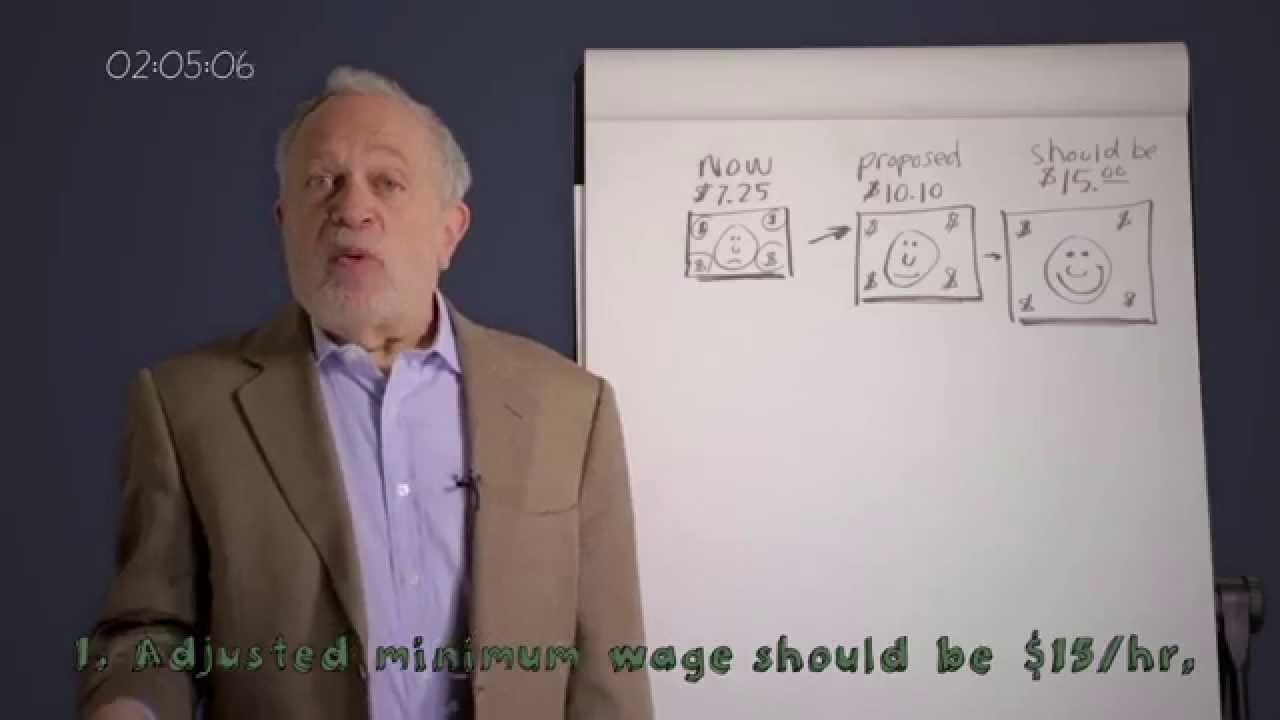
Robert Reich makes a much better argument than I.
[/quote]
Had to make myself watch this.
Because he’s a radical leftist - University of Berkeley >> Carter administration >> Clinton administration >> Obama economic adviser etc.
He advocates “wealth redistribution” by increasing taxes on the top 5%
[quote]florelius wrote:
A real and radical procedure would be too take out the ulcer( capitalism ). [/quote]
I complete disagree.
One argument that I see that is kinda bullshit is that people are saying that Fast Food work is just supposed to be for high school kids and that it was never intended to be done by “adults”. Well here in the DC area, most fast food restaurants are open until 1 AM. Some are open 24 hours. As a parent of a teenager, there’s no way my son is working that late on a school night (and that’s not including the time it takes to close down the restaurant).
By the very hours these establishments are open it is implied that they are using ADULT employees. And ADULTS have families. So if there is an industry being staffed by ADULTS, I feel that a wage that an ADULT can live on is appropriate. I don’t care if my burger costs another 50 cents more, if I’m stopping at fast food it’s because I’m hungry and failed to plan properly, so that’s just the price… Business will adjust.
Now I agree that not ALL business is open to inappropriate hours for a teenager to work, and those that close at a typical time have a good incentive to keep the minimum wage exactly where it is. But fast food is a different animal IMHO. Those workers should be paid more for the service they provide and the hours that they work.
One option could be to mandate a “shift differential” for all work performed between 11PM and 7AM. That could address some of this.
I would like to see some real world numbers on what kind of cost increases would happen by raising the minimum wage.
Not bullshit speculation of rhetoric, but how much more is a $5.99 Big Mac combo meal going to cost.
A local restaurant here took it upon themselves to show the added cost for providing healthcare for it’s employees on the receipt, letting customers know. It turned out to be a 3% increase, so a $30 meal cost an extra 90 cents. I can live with that. If it will stay at that rate is another story.
How about some real world numbers.
[quote]florelius wrote:
[quote]usmccds423 wrote:
[quote]Zeppelin795 wrote:
Also an increase in minimum wage is bad for an economy? Where are the studies, evidence that confirms this theory? Or should I just believe it cause it conforms to an ideology?
[/quote]
You should believe it because it’s basic economics.[/quote]
What kind of basic economics?
[/quote]
Those that happen in real life and not a text book.
[quote]florelius wrote:
If an increase in the minimum wage leads to an overall effect of improving the lifes of people stuck in low-wage employment and increasing Growth in Your domestic market, then I will say that a few bancrupt company’s is Worth the cost. As they say, you have to break some eggs to make a omelett.[/quote]
lmao… Yes, shrinking the already low job pool for unskilled workers is SURE to end in a net benefit for everyone…
jesus dude.
[quote]Zeppelin795 wrote:
I have little faith in theory, especially when in comes to economics and much more in evidence. Show me the evidence, not theory.[/quote]
Fucking priceless coming from a commie…
[quote]florelius wrote:
but if you want a capitalist system that is not living hell for most, [/quote]
WTF are you talking about?
You seriously need to crack a history book. Capitalism is such fucking hell, the people bitching about “I need $200 an hour to mop floors and pour coffee” shit into water that is still cleaner AFTER they shit in it, than billion’s of people’s drinking water.
Get the fuck out with this nonsense.
Several years ago, I was in Paris, and I walked into a McDonalds hoping to get a Royale with Cheese just for the novelty of it. After seeing on the menu that the burger alone - not the value meal - was over 6 euros, I said fuck it, novelty or not, I’m not paying $9 for a shitty McD burger. Why can European McDs afford to pay the higher minimum wage, mandatory benefits, etc? Because the price is passed along to the consumer.
McDs would be going out of business left and right if they started charging these prices in the U.S. This illustrates what is an uncomfortable truth to statists: making the low-cost end of the product spectrum essentially illegal (by setting price floors in input prices) destroys the ability of entrepreneurs to bring the cheapest and most affordable products to market. You know those that the poor might most be able to afford.